Boston strong

I’m fighting a really nasty cold—the kind that keeps you up most of the night and turns one whole side of your body into a big painful knot after coughing yourself awake too many times to count. I want to take a sick day here at The Flourishing Tree, but I also didn’t want the news of the day to go by without comment.

So if you want some words today about what a guilty verdict on all 30 counts means to this runner girl, take a look back at the words I wrote the day after the bombings two years ago. Or revisit my prayer for Boston 2014, which I’ll pray all over again in less than two weeks—because some wounds take longer to heal, and some prayers need praying again.

My Twitter feed is full of Boston and #BostonStrong today, and my favorite set of tweets comes from @OnlyInBOS (thanks to my sweet husband for bringing these to my attention):

BostonStrong Tweets_2015

“Evil may disrupt the race but can never win it.”

@OnlyinBOS goes on to ask for help focusing on those murdered instead of the man declared guilty today, to get the names of the dead to trend worldwide on Twitter. I’ll do my part in remembrance of them today so that we can all lift up the family and friends who still mourn the senseless loss of these four young lives:

Martin Richard

Krystle Campbell

Lu Lingzi

Sean Collier

And once I’m feeling stronger myself, I’ll be back with a story of some awe-inspiring runners. We runners are a resilient bunch. We may not all be fast enough to qualify to run Boston, but our hearts beat #BostonStrong.

Sharing the road

This past Saturday, friends of ours ran a marathon in the mountains. My husband—complete with cow bell and safety vest—volunteered to direct runners (and traffic) at one of the turns in the race. I was in full spectator mode and watched the race from three different spots along the course.

Not all of what I saw thrilled me: for one, the driver of the SUV who blew past my husband and sped toward runners who were in the process of crossing the road to make a turn in the course.

While many races close their courses to vehicular traffic, this particular race does not. It begins on a track and ends on another track, but in between, on curvy mountain roads, there are few places where vehicles aren’t allowed. Signs alert drivers to be aware of runners on the road. And many drivers are more cautious, move over to give runners room, and/or drive slower as they pass the runners. There are a few, though, who don’t give a rip.

Marathonsign2014_ft

The marathon course includes parts of the Blue Ridge Parkway, and because it cannot be closed during the race, park rangers step up patrols along the part where runners will be. Volunteers at the turns remind runners to run facing traffic, and for the most part, the runners heed these instructions. But there are some places along the course where the runners have to cross over, dodging cars that could be coming from either direction.

The SUV driver was coming from a direction where she would not yet have encountered runners in the road, but she would have passed caution signs warning of runners ahead. She had not been inconvenienced on her route up until the point where my husband stood in the middle of the road. She would have had to slow down for just four miles (a place where the speed limit is between 35 and 45 anyway), not an onerous amount of time to spend being decent to other human beings. She chose not to be inconvenienced, though. Who cared if these runners were tired? Who cared if they were in a zone and not as alert to their surroundings as they might usually be? Who cared if a car zipped by them too closely and too quickly? She clearly didn’t care.

As drivers, we may find it easy to ignore the fact that actual, live human beings are driving and riding in the cars around us. It’s too easy to dehumanize the other drivers around us. And I’m beginning to wonder if the same isn’t happening with some drivers’ (lack of) regard for cyclists and runners.

Other “objects” out on the road are simply obstacles to be dodged, like some great big real-world video game. Except that they’re not just objects, and you can’t earn more points by getting through the course faster or more recklessly. They’re humans. And the ones who aren’t in cars are more vulnerable.

Runnersandtractors2014_ft

When my friend saw this picture, he told me he had no recollection of running by a tractor. The tractor driver was courteous and safe and, therefore, deserving of a gold star.

Running has changed the way I drive and the way I perceive others out on the road, especially runners and cyclists. I have experienced moments in my running when I was so tired I knew I had to be extra careful with traffic. My mental reaction time had slowed because my brain was so focused on the running. When I’m running, my rule is this: never assume the driver sees me. And now when I’m driving: never assume the runner sees me.

Humans have a great capacity for kindness. We have an equally great capacity for being jerks. I’ve seen runners stop during a race to help a fallen runner. I’ve seen runners treat other runners rudely in the way they hog a trail or cut others off at a turn. I’ve seen cyclists stop to let runners pass safely through an intersection, and I’ve seen cyclists completely ignore runners, cars, other cyclists and stop signs so they won’t have to slow down.

We’re free to drive/cycle/run recklessly, but we’re also free to drive/cycle/run considerately (and only one of those deserves a ticket from the park ranger). We’re free to be kind, or we’re free to be insensitive. It’s up to each individual. I just wish more would choose the path of kindness and common decency. Like it or not, we’re all in this together.


Star-struck

“USA! USA! USA!” Those chants filled my TV yesterday, as I watched the US team succumb to Belgium in the World Cup round of death. I’ve never been a soccer fan (can’t quite call it football yet), but for some reason, this year, I watched as many of USA’s matches as I could. Maybe it was because of the hilarious commentary from Men in Blazers—a British duo that made me laugh and comprehend and hope for a long Team USA run in this World Cup. They seemed more patriotic about American football than most Americans I know. They made me crave cupcakes, too. (Fortunately, I haven’t caved to that craving yet, as I’m still trying to shed pounds from that cheese-laden trip to Vermont.)

But y’all know by now that soccer isn’t likely to replace my favorite sport: track and field. My husband and I journeyed to Sacramento this past weekend to see the US Track and Field National Championships. This is considered an off year because there are no Olympics or World Championships later in the season. It’s the only year in a four-year cycle that this happens. Nonetheless, we enjoyed attending this championship meet.

Womens10000mUSATF2014_FT

The women’s 10,000 meter race. Kim Conley (in the coral shorts, hip 17) won the race.

Mens5000mUSATF2014_FT

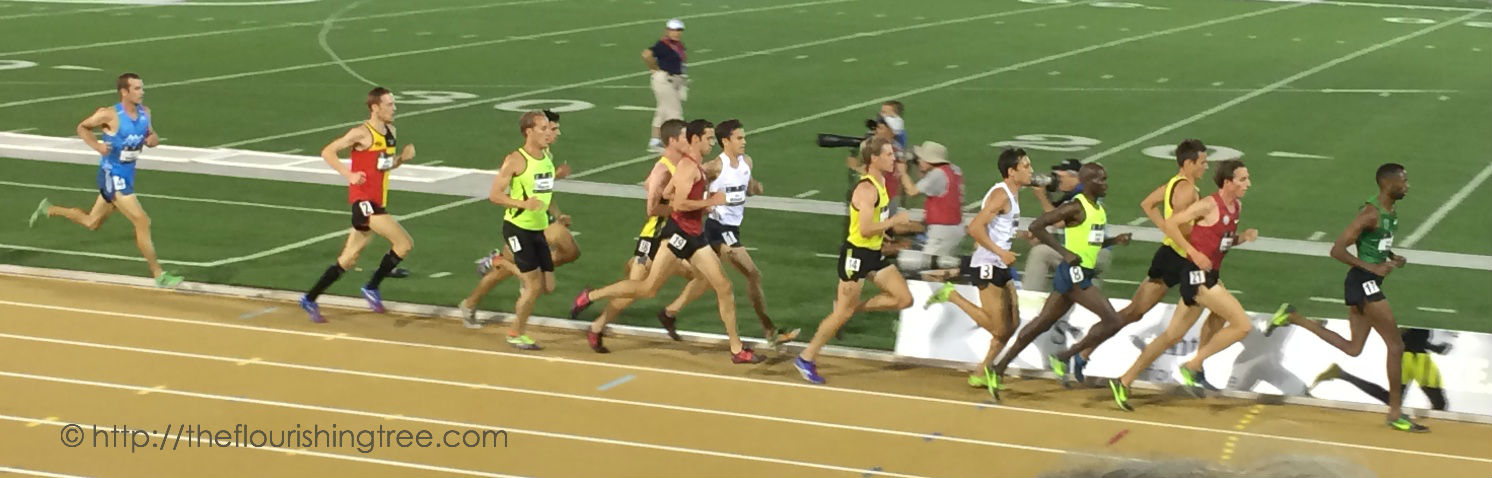
The men’s 5,000 meters. Bernard Lagat (hip 8, 4th from right) went on to win the race.

Some of the races are harder to cheer for than others. I mean, how do you cheer for one runner when there are three or four you’d love to see win? The men’s 5,000 was like that for me Friday night. If we had stayed for the men’s 1500, that race would have been even harder for me to pick who to cheer for.

Continue reading

Running cultures

I’m a southern girl living in a growing city. When I go out for a run in the morning, I know at least half of the runners I pass will greet me in some way. A nod or a wave, a “hello” or “mornin'” (we mostly drop that last -g around here).

I know a handful of cars will stop to let me cross roads, a few more will even move over to give me room to run along the shoulder, but I know that most cars’ drivers will not even notice me.

On my weekend runs, if I meet a Galloway group, I’ll hear a chorus of “Runner up! Runner up! Runner up!” trickle down the line of runners as we go by so the runners in back will move over to allow me room to run by. If I’m overtaking them, I’ll hear, “Runner back!” This practice amuses my husband, and he says it reminds him of the quacking of a mother duck and her line of ducklings. In addition to being amusing, it’s also really darn considerate.

What’s the running culture like where you live? Do runners greet each other and how? With a verbal greeting? A wave or maybe a thumb’s up?

Do cars stop to let you cross the street? Do you already have to be in the crosswalk for drivers to stop? Or do they stop if you’re waiting on the side of the road to cross? (Of all the places I’ve ever been, Maine is the best for this practice. Pat yourself on the back, Maine drivers.)

I ask you these questions because I’m still pondering different running cultures after a week’s vacation in New England. My husband and I visited three New England states and talked with each other about the different reactions we got while we were out running.

The first few days of our trip, we were in a coastal town with an asphalt path running along the edge of ocean cliffs. Our waves and “good mornings” were largely greeted with blank stares or stony silence. Some of the walkers and runners we passed seemed perplexed to hear our voices. A handful of folks we passed would respond in kind, but they were definitely the exception (and to be honest, we started to wonder if they were also visitors).

I met a Galloway group that Saturday morning running along the cliff path in the opposite direction from me, and instead of the usual “Runner up!” I hoped to hear, all I heard was the pounding of feet. Were they on some sort of death march that they could not acknowledge a fellow runner? I’ll admit it: they made me homesick. (In fairness, they may have preferred I stay home or at least stay off “their” path.) I passed them a second time on the way back to the beginning of the trail. Same silence.

Cars were kinder in this town, though, and even though not all stopped for me as I waited at a crosswalk, there were more who stopped for me than would have at a crosswalk in my own city. I waved as I crossed, probably branding myself as a tourist.

Ah, Boston
My husband and I stayed just outside of Boston proper for the next leg of our trip. Again, a few confused stares at our greetings, but I also had what almost qualified as a conversation with one runner (a sudden sound of rushing water had startled us both as we turned to the source thinking “Large animal?” It turned out to be a large drain dumping water into the river, and we laughed at our own jumpiness and wished each other a good run.). The few more responses I got made the run feel less lonely.

The community of runners may simply be more bonded together in Boston because of Boston’s history with running, and so running camaraderie may be more welcomed or expected there.

Next stop: the green state
In the final days of our trip, we headed north and stayed in a small town that boasts a national park and brushes up to the Appalachian Trail. I’ll admit that my sample size was pretty small on my run here, but the folks I passed mostly just gave me sideways glances as I ran by and called out “hello.” One woman with a dog smiled as I went by.

As my husband and I walked around the town later that day, we met an extremely friendly couple whose automatic garage door we stopped to admire/gawk at (it opened out instead of up!). We chatted for several minutes with them about the garage doors, the town and its must-sees, our own city. Their warmth took some of the sting out of my silent encounters on the morning’s run.

The next day, I was chatting with a doorman at the hotel while my husband went to get our car. He asked where I was from. I asked if he was from there. He said, “No, I’m from Mass.” He paused and then said, “It’s pretty much the same, though.” I was skeptical and told him so. He replied more honestly then. “No, the culture’s pretty different here.” I wondered if his initial response is just something he tells all the southern ladies so we go back with our stereotypes of New England intact.

I wanted to tell him that the running culture is different there, too.

How about where you live? Whether you’re out running or walking, do you greet the others you see? If I were to visit and passed you on a morning run, would you call out a greeting to me?

If you come to my city, I’ll be sure to wave or say hi. Well, unless I’m going up a steep hill. Then you may just have to settle for a slight nod.
The thrilling prospect of a personal worst

You’ll hear runners talk about PRs or PBs or BQs (personal record, personal best, Boston qualifier), but there’s one alphabet-soup abbreviation that most runners don’t like to think about, much less talk about: PWs, the personal worst time a runner has recorded for a given distance.

Runners revel in PBs. PBs mean that we’ve been working hard to accomplish greater speed and all the hard parts of our training plans are finally starting to pay off. And don’t even get me started about BQs. It’s an exciting goal to attain a qualifying time for Boston, a marathon where you must have a proven time to even get to register for the race. PWs, though? They’re just not fun.

But I have to admit: I’m pretty excited to try for a PW this weekend. Continue reading