Calling all good aunts, nieces, nephews and friends

It’s time to revisit the Good Aunt series, and I’ve decided to make it into a larger project. But making it bigger and better means I need your help.

So tell me, if you and I were walking and talking together and stopped to sit here for a few moments, what would you want to ask me? What would you want to tell me? What part of your stories would you want me to share?

Will you join me here for a conversation about good aunts?

Will you join me here for a conversation about good aunts?

I’m reaching out to you today to invite you to sit down with me and share conversations that matter with each other.

If you’re a woman who does not have children, if you’re a niece or nephew of a wonderful aunt who does/did not have children of her own, if you’re a friend of a woman whose story the world should know, I’d love to hear from you.

I’ve created a contact form with some questions to get the conversation started and to learn more about what you want to know about the woman you think of when you think of “good aunt.” The information you submit on the form will not be public. Only you and I will see your responses. (And let me assure you: You don’t even have to be a particularly good aunt or an aunt at all, but I’d still like to hear what you want to know about the topic.)

If the form is too daunting or bothersome for you, feel free to add your thoughts in the “Leave a Reply” section below, or simply email me. And please feel free to forward this post to anyone you think might like to participate. As I’ve said, I look forward to getting the conversation going.

← Back

Thank you for your response. ✨

Topics about women without children that interest you most:

I am:

Running thoughts

“Whoever has ears, let them hear.” – Revelation 13:9 (NIV)

________________________________________________

I ran a 10K this past weekend on a beautiful day that promised of early Fall. The race is well-organized every year, which means that, among other things, traffic control is well-done and volunteers are out at all turns where runners need directions about which way to go.

The course contains a lollipop section: an out-and-back part (you run the same road going and coming back, which makes the lollipop stick) with a loop at one end. From overhead, the course looks like a lollipop, hence the name.

The “circle” part of the lollipop for this particular race started near the 4-mile mark, where there was also a water stop. There were volunteers handing out water, and another volunteer whose sole job it was to point runners in the correct direction. Runners turned left to start the circle of the lollipop by running down a lovely hill. To leave the circle part, runners came down a gentle hill and turned left again, putting them back on the “stick” part of the course.

I was running back toward the end of the lollipop’s circle, ready to turn left onto the “stick” part of the course. And that’s when all the yelling started.

A runner approaching the water stop for the first time took a cup of water and then turned right instead of left. This put her running against the stream of runners coming back through the turn and meant she was off-course and heading into a needless uphill grind.

The volunteer was yelling to her to turn around. The runners coming toward her yelled to her to turn around. There was yelling and pointing and dodging as she continued heading the wrong way. Finally, she got the most puzzled look on her face when she looked directly into my eyes. I pointed the other direction and yelled again, “That way!”

She wasn’t dazed. She wasn’t delirious. She wasn’t near collapse. No. She was wearing earbuds.

“I know it’s fun, but you have to be able to hear!” That’s what the volunteer called out to her as she ran back by him. Who knows whether she heard or heeded his words.

Until the past few years, races’ insurance could be in jeopardy if competitors wore earbuds or headphones, and some race directors went so far as to say they would disqualify runners caught wearing them. But this rule has relaxed recently, and more and more runners wear earbuds during races.

The increased use of earbuds during races is a detriment to our sport, and I wish races would go back to encouraging runners to race without them.

Missing a race’s camaraderie
One of the reasons I love racing is the camaraderie that comes from pounding out mile after mile with other runners. I don’t like to chat while I run, but I do enjoy an occasional pleasantry with another runner, maybe a bit of encouragement after a tough hill or a “You can do it” when my energy flags. With more runners wearing earbuds, the sense of communal effort and support is beginning to dissipate, and I miss it.

Another reason I wish we could go earbud-free at races is for the spectators. I don’t need a group of cheerleaders on my daily runs, but at races, especially long ones or particularly hard ones, it’s nice to have folks cheering on the side of the road and ringing cowbells or whatever other noisemakers are in vogue. (I vote for a cowbell over a vuvuzela any day. Just my two cents’ worth.)

This past spring, my husband pointed out how much less fun it is to cheer for runner after runner who can’t hear the cheers because of earbuds. In the last few races I’ve watched, I’ve noticed this growing phenomenon, too. It discourages me as a spectator. I mean, I could have slept in and could be enjoying coffee and a good book on the porch swing. But I’m trying to support the runners out there. It’s a whole lot more fun when runners come by and acknowledge spectators’ presence with a smile, a wave or a even a call for “More cowbell!”

Many runners who like to wear earbuds and belt out tunes as they run should also know that just because they were born to run doesn’t mean they can (or should try to) sing it like the Boss. Though sometimes being near someone belting out an off-key song does spur me to run faster to get away sooner.

The safety in our hearing
Our sense of hearing is one of the best ways we runners can protect ourselves out on the roads, too, and it’s the safety issue that makes me also long for earbud-free races.

The truth is we are more vulnerable as runners than we like to admit, and being able to hear what’s coming up near us (car, bicycle, angry dog) is one of our best protections. Three years ago, a runner wearing an iPod died after a plane making an emergency landing hit him. I wonder if he could have lived if he had been running without the iPod.

Car back!
It’s common to hear “Car back!” or “Car up!” among runners and cyclists out together on the roadside. It’s a way of helping protect each other.

As I mentioned, the race this past weekend always has great traffic control, but it’s not perfect, and there are cars that end up driving alongside runners at certain points, especially some of the more residential sections of the race. Earlier in the race Saturday, I watched as a runner ahead of me did a 360-degree spin to avoid getting hit by a driver determined not to wait for runners to pass by before pulling into her driveway. What if the runner had been wearing earbuds and not heard the car or the runners near her yelling “Car back!”?

It all makes me think of the verse in Revelation (yes, I know this is wildly out of context). But I say to those of you who run, “Whoever has ears, let them hear.” Hear the cars coming. Hear the volunteers directing you. Hear the spectators cheering for you. Hear the beautiful rhythm of all those feet heading together for the same finish.

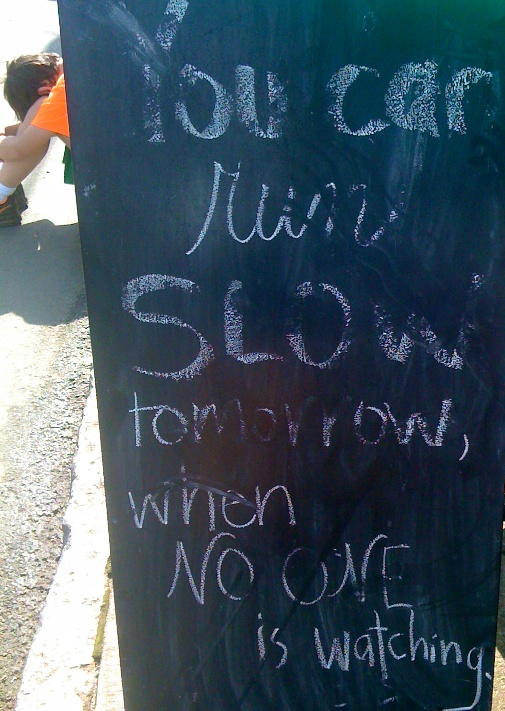
This sign sat near the start of the course Saturday. I think another good one might be: “You can run with an iPod tomorrow, when no one is cheering.” But please, leave at least one earbud out.

RunningSign2_2013

You can run slow tomorrow when no one is watching … I know, Mom, it should say “slowly.”

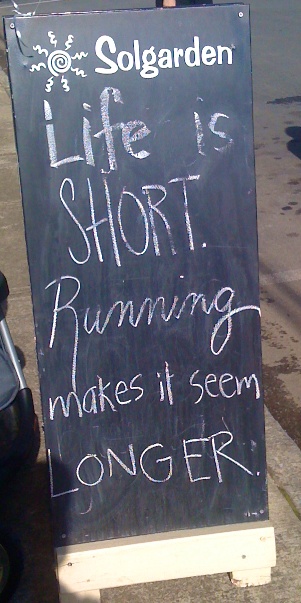
I add this second sign just for fun and conversation. A little encouragement goes a long way, and most runners I know appreciate fun signs along the course. I admit that this one puzzled me a bit, though:

RunningSign1_2013

My first thought when I saw this one: Makes it seem longer in a good way? Or in a bad way?

So I have a few questions for you runners out there. Does running make life seem longer to you? In a good way, I hope? Do you run with earbuds when you’re racing?

For you nonrunners out there, are there times and places where you get so caught up in your own electronic world that you miss the cheerleaders’ encouragement or the cars whizzing by? Are you willing to unplug to hear what you might be missing?

Gifts of figs and flowers

Those of you who have followed this blog since the beginning may remember how much I love figs. They were the subject of my very first post.

While it wasn’t anywhere near fig season when I wrote that original post, we’re right smack in the middle of it now. I pass by a laden fig tree every morning when I’m out walking the dog and have to fight the urge to pick a fig or two as I go by.

So when a friend of mine emailed me last week to ask if I’d like some figs from her tree, I responded with an enthusiastic yes (and probably a “Yippee!” in my head). She delivered them a few days later on her way to work.

Trayoffigs2013

A friend’s gift of figs

I was touched by the fact that she had even thought of me for the figs (instead of not thinking of me at all or instead of offering something I don’t love, like zucchini, for instance). Perhaps she remembered me talking about how much I like them? Whatever the reason, I am grateful she thought of me and even took the time to deliver them to my house.

Figscloseup2013

I had fun photographing them in the morning light, but it was hard to resist eating them before I was done snapping pictures.

Her simple act of kindness and friendship fueled me and fed me. And it made me wonder whether we take time often enough to look around at the simple abundances in our own lives and, instead of letting those gifts go to waste, think, “Who would enjoy this as a gift?”

Garden gifts
My mom always shared what she grew in the garden – including zucchini (which my brother and I wish she had shared all of instead of keeping any for us. Oh, the zucchini trauma stories we could tell).

She made the most beautiful bouquets of flowers to take to people and would even send bouquets of gardenias in to work with me because she knew I loved them so much. She doesn’t garden as much as she used to, but the flowers still bloom and create a beautiful space surrounding my parents’ house, and I like to think of her garden as a gift to her neighbors.

She has rubbed off on me that way. I try to plant flowers each year that will give me enough to share with others. And I save more random glass jars than most people, so that I can always have a “vase” handy.

However, there are still seasons of the gardening year that I haven’t quite figured out, and I hate those times when I want to bring someone flowers and head outside to find that nothing terribly pretty is blooming.

My mother-in-law loves gardening and giving flowers, too. She often sends me flowers for special occasions, and this is what arrived at my doorstep from her a few weeks ago:

Orchids2013

A beautiful gift of orchids

She knows I struggle with orchids (I do much better with outdoor plants that have a better chance of surviving my bouts of neglect), but she promised these are easy to care for. I really do hope I can keep the plant alive and blooming.

I love the way the afternoon light filters through the orchid’s petals.

Orchidbacklit2013

For those of you who garden, do you share what you grow? Do others share with you? Do you think it strengthens friendships to offer homegrown gifts or even store-bought gifts of fruit or flowers? For those of you who don’t garden, I’d love to hear what simple gifts you share with your friends. What ways do you share the crop of kindness and abundance from your own life with others?

Oh, and to my friends who live nearby (you know who you are), it’s baby lacebark elm tree season at my house. Let me know if you’d like one of the elms for your own yard. They’re a gift I’d love to share with you.

HOPE for vulnerable women and children

“And what does the Lord require of you
But to do justice, to love kindness,
And to walk humbly with your God?”
– Micah 6:8

—————————————

In the Great Lakes region, there’s an epidemic we don’t hear much about. Women and girls are suffering rape in great numbers, sometimes at the hands of gangs, and these women and girls then suffer the subsequent shaming that comes with rape. Many end up shut out of their families, giving birth to unwanted children, and mothers and children alike are ending up on the streets.

Haven’t heard about this in the news? Oh, perhaps you thought I meant the Great Lakes region in the United States? If that were the case, we North Americans would likely hear more about it. But this Great Lakes region is in the Democratic Republic of the Congo (DRC). Now before you decide to stop reading because you’re weary of atrocities in other countries far away from your own world of problems, I beg you to read this story and search your heart to see how God may be calling you to help.

The prevalence of rape in the DRC
The DRC is about a fourth of the size of the United States, and its vast wealth of minerals and other resources help explain the wars that ravage the country. Especially in the eastern part of DRC, the Great Lakes region I mentioned, rebel fighting continues with threats from neighboring Uganda and Rwanda never far enough away. Just this past Sunday and Monday, the city of Goma on the eastern edge of DRC was shelled in fighting that involved UN troops and rebels.

Yesterday, I met Maguy Makusudi, who is spending her vacation here in the United States raising awareness about her organization HOPE (Humanitarian Organization for People Empowerment).

She lives in Kinshasa, the capital of DRC, where she has lived since fleeing her home region of Kivu in eastern DRC in 1996 to escape war there. She still has family, including two sisters, who live in the eastern DRC and remain under threat of violence. Because of the prohibitive cost and difficulty of traveling from Kinshasa to her home region, Makusudi is rarely able to make the trip.

Makusudi traveled to my part of the United States thanks to a college friend of hers, who happens to be a member of my church (and who teasingly calls me one of his American nieces). Together, they are telling her story to all who will listen. It’s not an easy story. But I know that he is not only my African uncle but also my brother in Christ, and she is my sister in Christ, and as God’s family, we are called to share each others’ burdens.

The birth of HOPE
When Makusudi first arrived in Kinshasa, she saw the effects of war in the number of displaced children living on the streets: from abandoned children to child soldiers discharged from the army. She helped form HOPE in 2002 to aid these displaced children in retracing their families and negotiating with the families to reunite with these children.

It is better for the children to be reunited with their families, but this, she explains, is not always easy. Children born of rape are unwanted, and often the women themselves are cast out by their families instead of receiving comfort and care from them. Another mouth to feed is a burden many families are simply unwilling to accept. Makusudi also points out that many of these children are orphans, and it is the aunts or uncles who have no place for them and no willingness to take responsibility for their survival.

Accusing unwanted children of being witches is a common way of getting rid of them. Families take these children to local “churches,” where they are beaten or exorcised and then abandoned. Can you imagine this level of evil and negligence toward vulnerable children? Makusudi assures me it is the reality in the Congo.

A 2006 UNICEF census identified 20,000 children under the age of 18 living on the streets of Kinshasa alone. Makusudi says the problem has only grown worse as the cycle continues for girls growing up on the streets, being raped, or entering into prostitution to feed themselves and then also their children born into this horrific situation.

Where reunification is not possible, Makusudi works to place children in foster homes, a rare possibility in Kinshasa. For the others, HOPE’s center houses the children and provides schooling, healthcare and psychological counseling for them. HOPE partners with another organization to provide vocational training such as sewing or hairdressing classes so that the girls can gain skills that will give them a way out of life on the streets.

Even in the desert, a rose can bloom
Through the years, HOPE has seen its share of accolades and visits from prominent dignitaries. UN Secretary General Kofi Annan visited the center in 2006, and Unicef Italy recognized the center with a prize in 2002. Makusudi spoke of the award, a piece of sculpture depicting a desert rose. She explains, “Because even in the desert, a rose can bloom. Even in very hard situations, you can have a smile. You can have hope.”

HOPE is bringing smiles and hope to as many girls in Kinshasa as possible, currently housing girls from ages two through 18, with younger boys sometimes accompanying older sisters or mothers. The priority for acceptance at the center is given to very young girls and older girls who have babies, but for those who don’t get to come to the center, HOPE’s healthcare workers go out to the streets to treat women and their children when possible.

In addition to schooling and shelter, there are also games and team sports at the center, an attempt to give these children elements of a normal childhood. A pastor visits some Sundays, and when the center can find a van to rent, the girls will attend church two to three kilometers away, an outing they look forward to.

HOPE for the future
Makusudi has many hopes for her organization’s future growth. She’d love to expand services to the eastern part of the country, where she sees great need among the women ostracized from their communities and left vulnerable because they can no longer work in farming that leaves them open to more attacks. Micro-loans, healthcare and therapy, vocational training and a safe community for these girls and women can help them improve their lives.

HOPE is currently housed in buildings owned by another organization, and though HOPE owns land, there aren’t funds enough to begin building yet. Eventually, HOPE plans to build shelter, a healthcare center and a school for the girls they help.

Among these plans for HOPE’s future, you can see Makusudi dreaming of a better, safer Congo. She tells me that these are the ways you and I can help:

  • First and foremost, pray for the Congo in general and for peace in particular there. With peace would come renewed safety and opportunity for work, as well as a chance for families to rebuild.
  • Pray for the gang-raped women and girls.
  • Support HOPE with your gifts and service.
  • Visit Kinshasa to see how HOPE is at work saving the lives of these girls, giving them hope and helping them transform their lives.

We sat in a coffee shop bustling with people as Makusudi told me her story and her hopes for the organization. I thought how incongruous her visit here must seem compared to the daily heartbreak she witnesses in Kinshasa. She came here, though, because aren’t we all connected and called to kindness and justice and care for those who are more vulnerable than we are? Aren’t we all called to offer one another hope?

Toward the end of our conversation, I asked her to tell me what is most beautiful about the area of the Congo where she grew up, and she smiled large as she told me of the beautiful lakes and volcanoes (a few still active) and the beauty of the land that wows even European travelers. And I thought, this love of place connects us, too, this love of the beautiful world we call home. A place we should all work a little harder to make safer for our children.

Maguy Makusudi and me (taken by Joe Mabiala)

Maguy Makusudi and me (taken by Joe Mabiala)

I share her story with you because God charges us to act with mercy and love and “to do justice” (Micah 6:8). Will you help in Makasudi’s fight for justice for the children of DRC?

Want to learn more?

Makusudi is currently working with friends here in the United States to create an English-language website for HOPE, and I’ll share that link here as soon as the site is up and running.

In the meantime, here’s the contact information for the organization:

HOPE International
Asbl
KINSHASA RDC
39, Bld Lumumba, Q/Immo-Congo
Commune de Kalama/Kinshasa. Congo DRC

By phone:
Tel: +243 818110833; +243 815258301