The colors of Christmas: green

“O Christmas tree, O Christmas tree, how lovely are your branches!” If you’ve missed the other posts in this series, you can go back and read all about white Christmases and red poinsettias. But today’s color is one of my favorites: green.
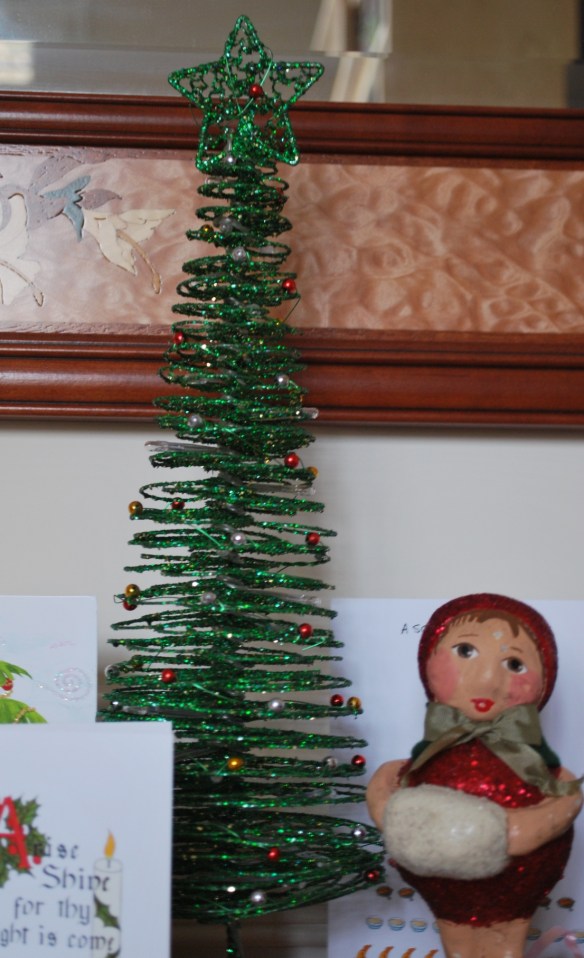
This little green tree decorates the table where we put all our Christmas cards.

This little green tree decorates the table where we put all our Christmas cards.

That green is one of my favorite colors shouldn’t surprise you, given the title of my blog and the fact that I write so frequently about trees. And unless you walk around with blinders on these days, you can’t go far without seeing some green of Christmas: trees, elf costumes, candy wrappers.

There are many conjectures about why green is one of the traditional colors of Christmas. Perhaps it’s because Italy’s flag had green in it. Or maybe the church set Christmas to coincide with pagan winter solstice celebrations, complete with their evergreen trees. Some sources suggest we celebrate with green trees because the German church in the 1300s used pines decorated with red apples to suggest a “paradise tree” in plays about Adam and Eve and the tree in the garden of Eden. Or maybe green is so popularly associated with Christmas because of holly plants, with their green, waxy leaves and bright red berries: Continue reading

If there’s confetti, it must be a party

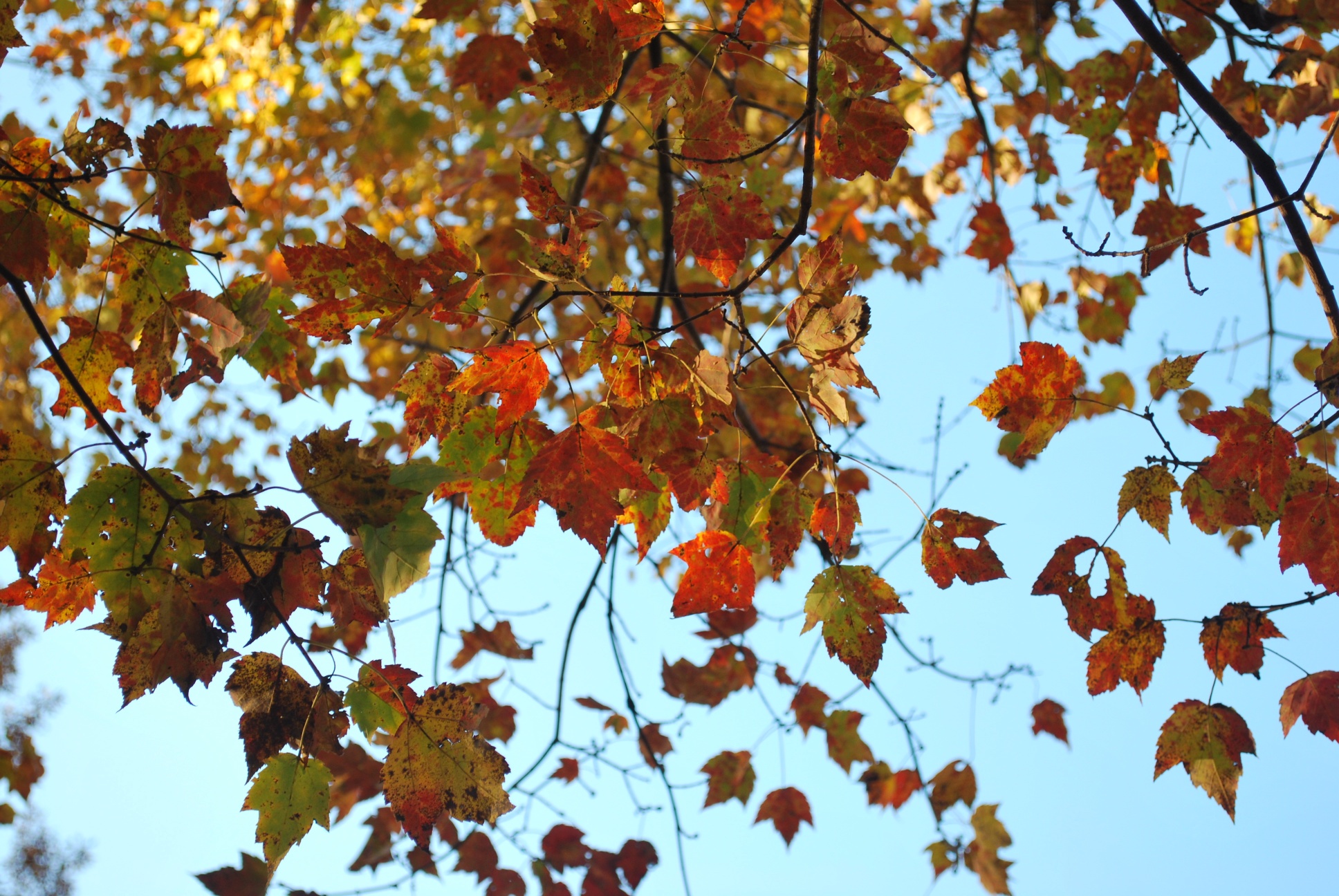
I looked out of my office window on Monday and saw what looked like a party going on in my yard, with leaf confetti fast becoming a thick blanket of decoration:

Fallen leaves mix with the orange lantana remnants to create a medley of nature’s confetti.

The source of the confetti is all of our trees, lately having to decided to get with the autumn program, change color and drop leaves everywhere.

Just one source of the confetti in the yard

It’s like God is throwing a party and decorating the earth with brilliant colors to remind us of how beautiful life can be, even as winter looms.

Confetti for my artist’s date
Lately, I’ve felt a bit like the dried-up leaves on the ground, not the pretty reds and golds and bright oranges newly fallen and confetti-like, but instead like the crisped brown ones that crunch when you step on them and hitch a ride into the house on the dog’s feet.

I realized I’ve been ignoring my artist’s date, a term Julia Cameron defines in her book The Artist’s Way as a weekly solo date that she insists is essential for any creative person who wants to make creativity sustainable. So I decided to set out in search of more confetti for my artist’s date. And I knew exactly where to find it.

Continue reading

Trail Tales

Most of my friends know that I don’t especially love reading non-fiction. When I pick up a book, I usually prefer to escape the real world and go to a fictional place.

But a dear friend from childhood – the friend I totally and completely bonded with in fifth grade because we both loved reading and loathed field day in equally passionate measure – has enthusiastically taken up with camping and hiking. For months, she kept telling me to read Jennifer Pharr Davis’ Becoming Odyssa, a book Davis wrote after hiking the Appalachian Trail. I figured I’d get around to reading it some day.

The same friend loaned me her copy of Cheryl Strayed’s Wild: From Lost to Found on the Pacific Crest Trail. Her prologue begins with her looking out over the trees:

The trees were tall, but I was taller, standing above them on a steep
mountain slope in northern California. Moments before, I’d removed
my hiking boots and the left one had fallen into those trees, first cata-
pulting into the air when my enormous backpack toppled onto it, then
skittering across the gravelly trail and flying over the edge. It bounced
off of a rocky outcropping several feet beneath me before disappearing
into the forest canopy below, impossible to retrieve. (3)

She had me hooked. That was the start of my adventures into trail tales. And because I surprised myself by actually enjoying a book about Strayed’s solo hike, I picked up Becoming Odyssa, too.

My recent reads about thru-hiking

Those of you who know me best may be wondering why I’d even read the stories of women hiking the entire Pacific Crest Trail (Cheryl Strayed) and the Appalachian Trail (Jennifer Pharr Davis), given my own aversion to lots of outdoorsy activities and critters. Like stream crossings and big spiders and a lack of hot running water. But most especially snakes. Continue reading

Tree tourism

A dear friend asked me last summer what my favorite tree is. I think of her question often, especially when I’ve found some new tree (new to me anyway). Is this new tree my favorite? Or is there one from home that’s irreplaceable in my heart? I’m never quite sure of the answer, and it probably changes with the seasons.

One of my favorite parts of traveling somewhere new is taking along a camera to capture memories of the place to take home with me. And I especially love photographing new or strange trees.

This past weekend found me in Santa Barbara, California, with its juxtaposition of native desert plants and tropical plants that require a lot of irrigation to thrive. I came across several fun trees, and I wanted to share a few of them with you here. Continue reading

Branching out

In his preface to The Great Divorce, C.S. Lewis writes of life – and its decisions – being like a tree:

We are not living in a world where all roads are radii of a circle and where all, if followed long enough, will therefore draw gradually nearer and finally meet at the centre: rather in a world where every road, after a few miles, forks into two, and each of those into two again, and at each fork you must make a decision. Even on the biological level life is not like a river but a tree. It does not move towards unity but away from it and the creatures grow further apart as they increase in perfection. Good, as it ripens, becomes continually more different not only from evil but from other good. (p. viii) Continue reading