When being an aunt isn’t all sunshine and roses

In Committed, Elizabeth Gilbert writes of aunts:

Often able to accrue education and resources precisely because
they were childless, these women had spare income and compassion
to pay for lifesaving operations, or to rescue the family farm, or to take
in a child whose mother had fallen gravely ill. I have a friend who calls
these sorts of child-rescuing aunties “sparents”—”spare parents”—
and the world is filled with them.

Even within my own community, I can see where I have been vital
sometimes as a member of the Auntie Brigade. My job is not merely to
spoil and indulge my niece and nephew (though I do take that assignment
to heart) but also to be a roving auntie to the world—an ambassador
auntie—who is on hand wherever help is needed, in anybody’s family whatsoever. … In this way, I, too, foster life. There are many, many ways
to foster life. And believe me, every single one of them is essential.
(192-3)

Gilbert’s discussion of “sparents” and their ways of fostering life reminds me of a story I heard on NPR’s StoryCorps back in March. Abby Libman’s life changed forever when her brother-in-law killed Abby’s twin sister, leaving behind two children (ages 7 and 4), whom Abby took in and raised. I encourage you to listen to the brief interview between Libman and her now 23-year-old nephew. For Libman, her role shifted from aunt to mother, and as she navigated through that difficult time, she was most importantly fostering the lives of those two precious young children who would grow up to think of her as “mom.” She was the ultimate “good aunt” to her sister’s children. Continue reading


When you need an extra set of hands … or clothes for the frog

In Elizabeth Gilbert’s book Committed, she writes mostly about marriage but devotes some of her words to aunthood and its role in human populations across time and place:

… here’s an astonishing fact that I discovered in the margins of my
research on marriage: If you look across human populations of all
varieties, in every culture and on every continent (even among the
most enthusiastic breeders in history, like the nineteenth-century Irish,
or the contemporary Amish), you will find that there is a consistent 10
percent of women within any population who never have children at all.
The percentage never gets any lower than that, in any population
whatsoever. In fact, the percentage of women who never reproduce in
most societies is usually much higher than 10 percent—and that’s not
just today in the developed Western world, where childless rates
among women tend to hover around 50 percent. …

In any case, the number of women throughout history who never
become mothers is so high (so consistently high) that I now suspect
that a certain degree of female childlessness is an evolutionary
adaptation of the human race. Maybe it’s not only perfectly legitimate
for certain women to never reproduce, but also necessary. It’s as
though, as a species, we need an abundance of responsible,
compassionate, childless women to support the wider community
in various ways. Childbearing and child rearing consume so much
energy that the women who do become mothers can quickly become
swallowed up by that daunting task—if not outright killed by it. Thus,
maybe we need extra females, women on the sidelines with undepleted
energies, who are ready to leap into the mix and keep the tribe supported.
(190-191) Continue reading

The good aunt’s family

In last week’s post, I talked with you about some questions to avoid when talking with someone who doesn’t have children. This week, I want to encourage you to ask a broader question beyond the typical, “Do you have children?”

When you learn that a person doesn’t have children, you may want to consider asking about that person’s family and friends. After all, good aunts have people in our lives we love (and love telling you about), but our family may not look like a conventional one.

A good aunt’s family may not look like this one

I don’t know when those little family stickers started popping up on minivans and SUVs, but I do know it’s hard to drive down the highway without seeing a few of them. Some of them are cute, some puzzling and some simply bizarre. (On a trip this past weekend, my husband and I saw one with goat stickers next to the rest of the family. Very strange.) Continue reading

The dreaded follow-up question

Before I dive in to today’s installment of “The Good Aunt” series, let me take a moment to thank all of you who have served your country and made sacrifices to keep us all safe and free. There are men and women throughout the history of this country who have sacrificed their futures (including some who never had the opportunity to have families) so that others’ futures would be enriched. I am humbly grateful for what you have given this country.

A Memorial Day thanks to all who sacrificed their dreams and futures to keep us safe

The expected question
“Do you have children?” For those of us good aunts (and uncles, too) who do not have children, we know that the first question is coming. It’s one we ask those we meet, and we expect it to be asked of us, too. This question is not a big problem, though for men and women trying desperately to have children, even this question can cause a jab of pain.

But that first question is one we all accept. It’s part of the “get-to-know-you” package of questions that anyone of a certain age gets asked: Where are you from? Where do you work? Are you married? Do you have children? Continue reading

A good aunt’s influence

Thanks for joining me for the second installment of “The Good Aunt” series. Today, I’d like to share some stories with you from the women I interviewed and from my own life about the role models our own aunts were for us.

There are as many different ways an aunt can influence as there are different types of aunts: free spirits and disciplinarians, great cooks and those who loved takeout, teachers, nurses, career women, homemakers, aunts who had children of their own and aunts who were childless, aunts who lived with us and aunts who lived many hours away.

Two of the women I interviewed spoke of aunts whose presents they always especially looked forward to unwrapping, because they knew it would be something special: a prized treasure from an exotic location or another piece of a special collection dear to that child’s heart.

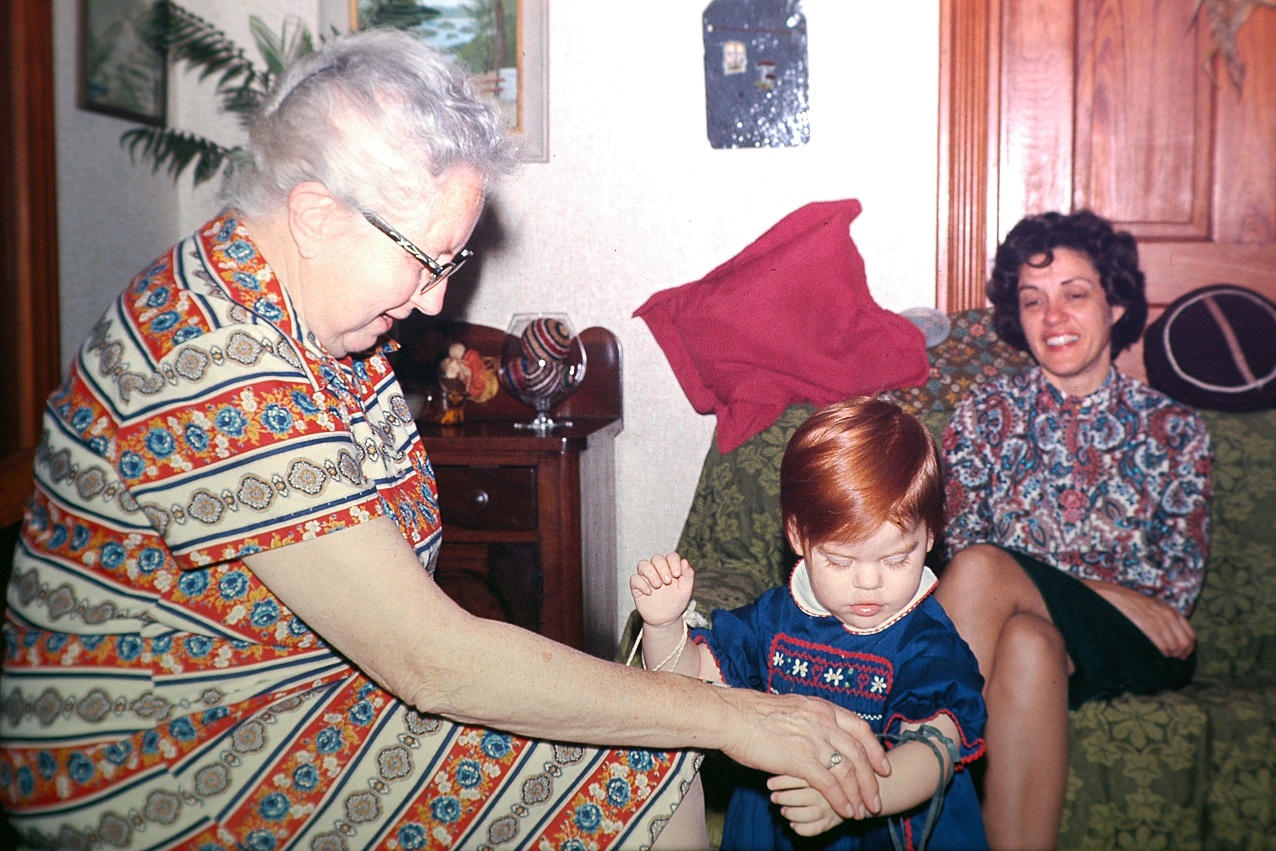
One of my beloved great aunts entertaining me while my mom looks on

Continue reading