Gifts of figs and flowers

Those of you who have followed this blog since the beginning may remember how much I love figs. They were the subject of my very first post.

While it wasn’t anywhere near fig season when I wrote that original post, we’re right smack in the middle of it now. I pass by a laden fig tree every morning when I’m out walking the dog and have to fight the urge to pick a fig or two as I go by.

So when a friend of mine emailed me last week to ask if I’d like some figs from her tree, I responded with an enthusiastic yes (and probably a “Yippee!” in my head). She delivered them a few days later on her way to work.

Trayoffigs2013

A friend’s gift of figs

I was touched by the fact that she had even thought of me for the figs (instead of not thinking of me at all or instead of offering something I don’t love, like zucchini, for instance). Perhaps she remembered me talking about how much I like them? Whatever the reason, I am grateful she thought of me and even took the time to deliver them to my house.

Figscloseup2013

I had fun photographing them in the morning light, but it was hard to resist eating them before I was done snapping pictures.

Her simple act of kindness and friendship fueled me and fed me. And it made me wonder whether we take time often enough to look around at the simple abundances in our own lives and, instead of letting those gifts go to waste, think, “Who would enjoy this as a gift?”

Garden gifts
My mom always shared what she grew in the garden – including zucchini (which my brother and I wish she had shared all of instead of keeping any for us. Oh, the zucchini trauma stories we could tell).

She made the most beautiful bouquets of flowers to take to people and would even send bouquets of gardenias in to work with me because she knew I loved them so much. She doesn’t garden as much as she used to, but the flowers still bloom and create a beautiful space surrounding my parents’ house, and I like to think of her garden as a gift to her neighbors.

She has rubbed off on me that way. I try to plant flowers each year that will give me enough to share with others. And I save more random glass jars than most people, so that I can always have a “vase” handy.

However, there are still seasons of the gardening year that I haven’t quite figured out, and I hate those times when I want to bring someone flowers and head outside to find that nothing terribly pretty is blooming.

My mother-in-law loves gardening and giving flowers, too. She often sends me flowers for special occasions, and this is what arrived at my doorstep from her a few weeks ago:

Orchids2013

A beautiful gift of orchids

She knows I struggle with orchids (I do much better with outdoor plants that have a better chance of surviving my bouts of neglect), but she promised these are easy to care for. I really do hope I can keep the plant alive and blooming.

I love the way the afternoon light filters through the orchid’s petals.

Orchidbacklit2013

For those of you who garden, do you share what you grow? Do others share with you? Do you think it strengthens friendships to offer homegrown gifts or even store-bought gifts of fruit or flowers? For those of you who don’t garden, I’d love to hear what simple gifts you share with your friends. What ways do you share the crop of kindness and abundance from your own life with others?

Oh, and to my friends who live nearby (you know who you are), it’s baby lacebark elm tree season at my house. Let me know if you’d like one of the elms for your own yard. They’re a gift I’d love to share with you.

HOPE for vulnerable women and children

“And what does the Lord require of you
But to do justice, to love kindness,
And to walk humbly with your God?”
– Micah 6:8

—————————————

In the Great Lakes region, there’s an epidemic we don’t hear much about. Women and girls are suffering rape in great numbers, sometimes at the hands of gangs, and these women and girls then suffer the subsequent shaming that comes with rape. Many end up shut out of their families, giving birth to unwanted children, and mothers and children alike are ending up on the streets.

Haven’t heard about this in the news? Oh, perhaps you thought I meant the Great Lakes region in the United States? If that were the case, we North Americans would likely hear more about it. But this Great Lakes region is in the Democratic Republic of the Congo (DRC). Now before you decide to stop reading because you’re weary of atrocities in other countries far away from your own world of problems, I beg you to read this story and search your heart to see how God may be calling you to help.

The prevalence of rape in the DRC
The DRC is about a fourth of the size of the United States, and its vast wealth of minerals and other resources help explain the wars that ravage the country. Especially in the eastern part of DRC, the Great Lakes region I mentioned, rebel fighting continues with threats from neighboring Uganda and Rwanda never far enough away. Just this past Sunday and Monday, the city of Goma on the eastern edge of DRC was shelled in fighting that involved UN troops and rebels.

Yesterday, I met Maguy Makusudi, who is spending her vacation here in the United States raising awareness about her organization HOPE (Humanitarian Organization for People Empowerment).

She lives in Kinshasa, the capital of DRC, where she has lived since fleeing her home region of Kivu in eastern DRC in 1996 to escape war there. She still has family, including two sisters, who live in the eastern DRC and remain under threat of violence. Because of the prohibitive cost and difficulty of traveling from Kinshasa to her home region, Makusudi is rarely able to make the trip.

Makusudi traveled to my part of the United States thanks to a college friend of hers, who happens to be a member of my church (and who teasingly calls me one of his American nieces). Together, they are telling her story to all who will listen. It’s not an easy story. But I know that he is not only my African uncle but also my brother in Christ, and she is my sister in Christ, and as God’s family, we are called to share each others’ burdens.

The birth of HOPE
When Makusudi first arrived in Kinshasa, she saw the effects of war in the number of displaced children living on the streets: from abandoned children to child soldiers discharged from the army. She helped form HOPE in 2002 to aid these displaced children in retracing their families and negotiating with the families to reunite with these children.

It is better for the children to be reunited with their families, but this, she explains, is not always easy. Children born of rape are unwanted, and often the women themselves are cast out by their families instead of receiving comfort and care from them. Another mouth to feed is a burden many families are simply unwilling to accept. Makusudi also points out that many of these children are orphans, and it is the aunts or uncles who have no place for them and no willingness to take responsibility for their survival.

Accusing unwanted children of being witches is a common way of getting rid of them. Families take these children to local “churches,” where they are beaten or exorcised and then abandoned. Can you imagine this level of evil and negligence toward vulnerable children? Makusudi assures me it is the reality in the Congo.

A 2006 UNICEF census identified 20,000 children under the age of 18 living on the streets of Kinshasa alone. Makusudi says the problem has only grown worse as the cycle continues for girls growing up on the streets, being raped, or entering into prostitution to feed themselves and then also their children born into this horrific situation.

Where reunification is not possible, Makusudi works to place children in foster homes, a rare possibility in Kinshasa. For the others, HOPE’s center houses the children and provides schooling, healthcare and psychological counseling for them. HOPE partners with another organization to provide vocational training such as sewing or hairdressing classes so that the girls can gain skills that will give them a way out of life on the streets.

Even in the desert, a rose can bloom
Through the years, HOPE has seen its share of accolades and visits from prominent dignitaries. UN Secretary General Kofi Annan visited the center in 2006, and Unicef Italy recognized the center with a prize in 2002. Makusudi spoke of the award, a piece of sculpture depicting a desert rose. She explains, “Because even in the desert, a rose can bloom. Even in very hard situations, you can have a smile. You can have hope.”

HOPE is bringing smiles and hope to as many girls in Kinshasa as possible, currently housing girls from ages two through 18, with younger boys sometimes accompanying older sisters or mothers. The priority for acceptance at the center is given to very young girls and older girls who have babies, but for those who don’t get to come to the center, HOPE’s healthcare workers go out to the streets to treat women and their children when possible.

In addition to schooling and shelter, there are also games and team sports at the center, an attempt to give these children elements of a normal childhood. A pastor visits some Sundays, and when the center can find a van to rent, the girls will attend church two to three kilometers away, an outing they look forward to.

HOPE for the future
Makusudi has many hopes for her organization’s future growth. She’d love to expand services to the eastern part of the country, where she sees great need among the women ostracized from their communities and left vulnerable because they can no longer work in farming that leaves them open to more attacks. Micro-loans, healthcare and therapy, vocational training and a safe community for these girls and women can help them improve their lives.

HOPE is currently housed in buildings owned by another organization, and though HOPE owns land, there aren’t funds enough to begin building yet. Eventually, HOPE plans to build shelter, a healthcare center and a school for the girls they help.

Among these plans for HOPE’s future, you can see Makusudi dreaming of a better, safer Congo. She tells me that these are the ways you and I can help:

  • First and foremost, pray for the Congo in general and for peace in particular there. With peace would come renewed safety and opportunity for work, as well as a chance for families to rebuild.
  • Pray for the gang-raped women and girls.
  • Support HOPE with your gifts and service.
  • Visit Kinshasa to see how HOPE is at work saving the lives of these girls, giving them hope and helping them transform their lives.

We sat in a coffee shop bustling with people as Makusudi told me her story and her hopes for the organization. I thought how incongruous her visit here must seem compared to the daily heartbreak she witnesses in Kinshasa. She came here, though, because aren’t we all connected and called to kindness and justice and care for those who are more vulnerable than we are? Aren’t we all called to offer one another hope?

Toward the end of our conversation, I asked her to tell me what is most beautiful about the area of the Congo where she grew up, and she smiled large as she told me of the beautiful lakes and volcanoes (a few still active) and the beauty of the land that wows even European travelers. And I thought, this love of place connects us, too, this love of the beautiful world we call home. A place we should all work a little harder to make safer for our children.

Maguy Makusudi and me (taken by Joe Mabiala)

Maguy Makusudi and me (taken by Joe Mabiala)

I share her story with you because God charges us to act with mercy and love and “to do justice” (Micah 6:8). Will you help in Makasudi’s fight for justice for the children of DRC?

Want to learn more?

Makusudi is currently working with friends here in the United States to create an English-language website for HOPE, and I’ll share that link here as soon as the site is up and running.

In the meantime, here’s the contact information for the organization:

HOPE International
Asbl
KINSHASA RDC
39, Bld Lumumba, Q/Immo-Congo
Commune de Kalama/Kinshasa. Congo DRC

By phone:
Tel: +243 818110833; +243 815258301

Lessons from red geraniums

My mother-in-law recently shared a story with me about her red geraniums, and it got me thinking about geraniums and what they can teach us about life.

She lives in a climate where geraniums are perennial (not always the case where I live). Many years ago, a gardener who had beautiful geraniums gave my mother-in-law four cuttings from her plants, and for years, my mother-in-law kept them in pots and trimmed them or broke off stems when they started to outgrow the pots. But then she decided to start planting them in the ground at her home and her church. She also began giving away cuttings from neighbors and friends (and friends of friends) who asked for them. She told me she feels like the Johnny Appleseed of geraniums.

I love this story for many reasons. One is that I love geraniums, especially red ones. I love their smell and their fuzzy stems and their cheerful blooms. As I said, geraniums don’t always come back from one season to the next where I live, and when they do, they’re usually much punier than the first year:

Lastyearsgeraniums2013

Though the blooms were larger last year, I’m still happy for this geranium to have come back this summer.

I managed to buy a really strange variety this summer and have been disappointed with how sparse they look. I guess I just prefer the big clomps of blooms that I get with standard geraniums.

Thisyearsgeraniums2013

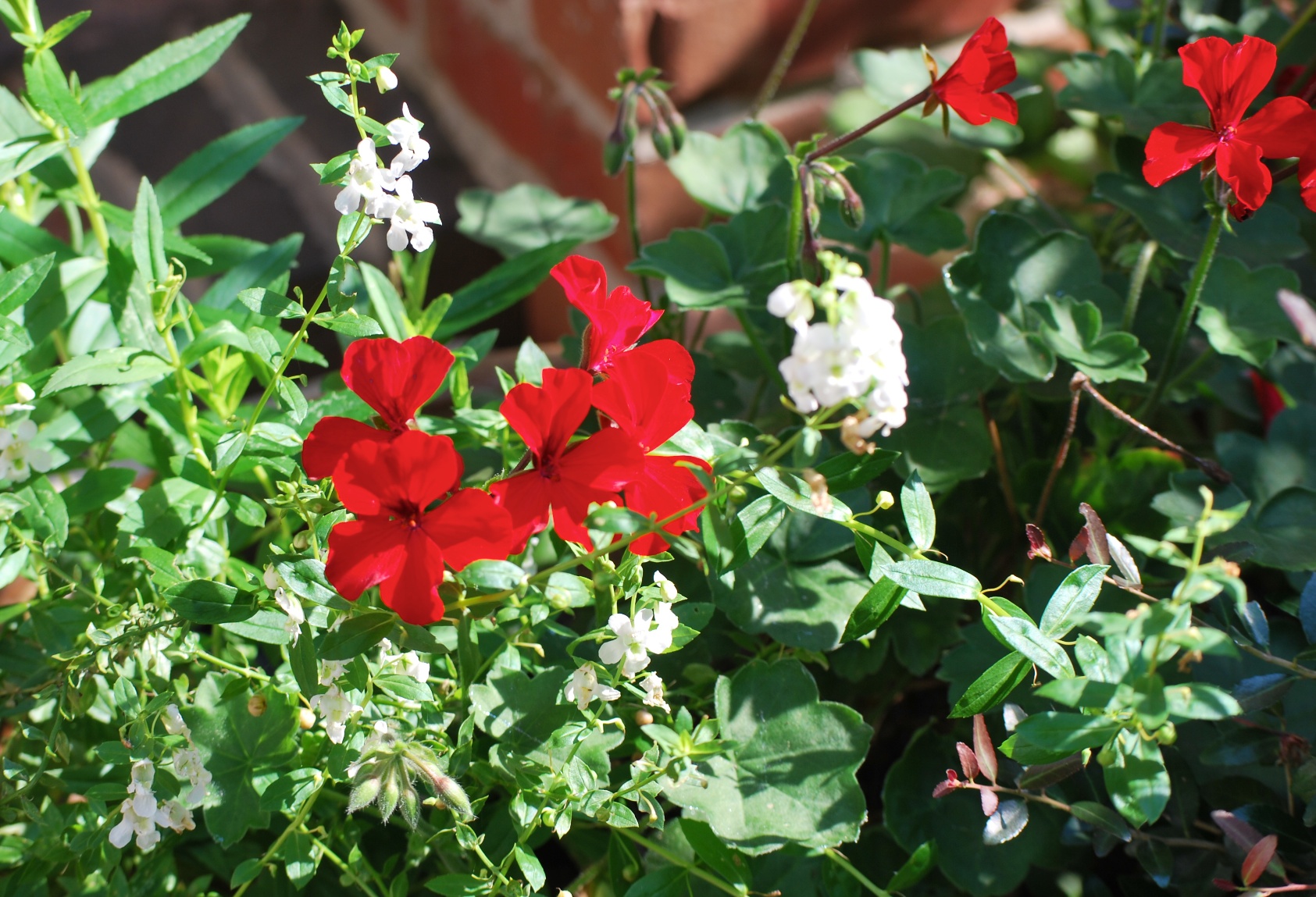
The new variety of geranium I planted this year isn’t my favorite, but I still like the pop of color they add to the front porch.

I love her story because it was a response to one of my blog posts, and her response to my writing is one of the things I cherish about her. She is always so encouraging and excited about what I’m working on. Her sharing this story was a way to connect with me and let me know she cares about my vocation and my avocations. I do not take this for granted.

I also love this story because of the lessons it can teach us about what we share with others, not just in the garden but also in life. In the case of my mother-in-law, she took a gift and multiplied it, sharing her talent for gardening and a gift of beauty with others near and far. She could have kept them all for herself, but she reached out with a gift to others.

For those of you who garden or have yards to care for, imagine the difference between a neighbor who shares beautiful flowers with you as opposed to the neighbor who – through neglect – shares weeds and tangled mess with you. Or maybe you’re the neighbor sharing the poison ivy vines? (I don’t judge: poison ivy can sprout up quickly and in the most expected places!)

In this same way, we choose what we share in life, too. We can share flowers or weeds with everyone around us in the way we speak to them, treat them and even ignore them. We can put up a thorny exterior that keeps others away from us, or we can be soft and fuzzy and inviting like those geranium stems, and cheerful like their blossoms.

I hope you’ll take a moment in the coming days to think about what you share with others. If you need a tangible reminder of what you want to share, put a red geranium on your front porch to remind you each time you leave your house that only you can choose what you give to the world.

A good aunt’s back-to-school advice

It’s back-to-school season, and I thought I’d put on my “good aunt” hat for a few moments and share some advice with you (most of it fitting whether you’re a child, a teenager, a young adult, a student, a parent, a teacher).

On starting college
Two summers ago, I wrote a blog post for two beloved young people in my life who were heading off to college. There’s a fresh batch of young people I know starting college this year. I know you’re busy finding where your classes are and trying to decide whether you like your roommate and figuring out how many times you can text your mom and still be cool. But I hope you’ll take time to read what I wrote. Everything in it is still true today.

On texting and driving
If you drive yourself or your children to school (or anywhere else), please take 35 minutes today to watch this film on texting and driving. Called From One Second to the Next, this film brings us the accounts of people whose lives were changed in a split second because of a driver’s decision to text while driving. For any of you with a driver’s license and a car, please watch this video. Commit to checking your text messages once you get to where you’re going. Commit to refusing to ride in a car with a driver who is texting. Commit to waiting to text a friend who is behind the wheel. No one should die because of an oh-so-important message: “LOL.” “Running late.” “Almost there.”

On appreciating your teachers and other school staff
Did you hear yesterday’s story of a school clerk who talked a gunman into putting down his weapons and letting police arrest him before he killed anyone? The photo at the top of the story shows a good aunt reaching out for the hand of her nephew, one of the precious children the school clerk helped save yesterday. The clerk, Antoinette Tuff, said, “I’m not the hero. I was terrified.”

I don’t agree with Tuff. Nelson Mandela said, “I learned that courage was not the absence of fear, but the triumph over it. The brave man is not he who does not feel afraid, but he who conquers that fear.” Tuff is a hero. She overcame her terror and put her own life on the line to save the others in her school and community.

Appreciate your teachers, even if you don’t enjoy their class or teaching style. They may be the single thread that protects your life in a moment of terror.

On working hard
“School is hard.” This profound bit of truth comes from an eighth grader I know.

For some of you – I’m thinking especially of the high school seniors and college freshmen among you – there may be a temptation to play a little too hard. Just remember why you’re in school. First and foremost, you’re there to learn and to work hard. Learning how to add in the rest (the fun parts) is the first step toward becoming a well-rounded adult while also discovering the parts of life that fuel your passions.

On finding joy
While some of you parents out there – and even some of you students, too – may be overjoyed at the prospect of a new school year, others of you will have to work a little harder to find joy in school. But it’s worth the effort to find something you love about school. Try a new activity or class, or try out for a team or the school play. These extras give you an opportunity to learn more about yourself and forge strong bonds with friends new and old. School may be hard (see previous category), but it doesn’t have to be miserable.

On keeping the faith
Whether it was Vacation Bible School, a youth mission trip or just fun, relaxed summertime visits at church, you may have experienced some great “mountaintop” moments in your faith while school was out. Look for ways to carry those moments with you into the school year, and if you’re a college student, I encourage you to get tapped into a faith community near your college – even if you really, really loved your home church youth group and think you’ll come home every weekend to see your familiar friends there.

When I was in college, my faith was sometimes the only thread that held me together while it seemed like everything else was falling apart around me. Give yourself a gift of a community of faith wherever you are. Keep looking if the first place you land doesn’t quite fit. Faith and a community of believers will strengthen you in ways nothing else can.

For those of you past your own school years, do you have any advice for these young ones going back to school?

For those of you going back to school, do you have any advice you’d like to get from my readers?

If so, I hope you’ll add it to the comments below.

When the world is silent about your dreams

“And do not be conformed to the world, but be transformed by the renewing of your mind, so that you may prove what the will of God is, that which is good and acceptable and perfect.” Romans 12:2

__________________

My husband and I have been TV junkies this week, thanks to the World Track & Field Championships going on in Moscow. There’s typically about four hours of live coverage for us to record overnight and then two more hours mid-day. So when we settle in for the evening, we take our dinner and sit on the couch and try to go through the six or so hours of coverage as quickly as possible. Afterward, I catch up on Facebook and Twitter, sites I dodge throughout the day so I don’t see outcomes of any of the race.

It’s an exciting week to be a track and field fan, but it’s frustrating, too. NBC never shows enough of the distance races, instead breaking up a lap or two here and there with field events and even a news story about anticipated trouble in the upcoming winter Olympics, which will be held in the Soviet Union. There’s a time and place for those stories, but right in the middle of a 10,000 meter race? Not the time.

I’ve also been struck by NBC’s poor announcing. I mean, I expect poor announcing in general from the network, because NBC seems unwilling to hire commentators who get excited about what they’re watching, but specifically, I’m shocked when they don’t even mention an American athlete’s name during a race. This is an American broadcasting company, and its commentators can’t bother to name all three Americans running in a particular race?

Continue reading