Running roots

I’ve mentioned my love of running before, but these days, it takes up a lot of my thoughts. Just a few short weeks ago, I registered to run my first marathon and sat down with my husband (who also happens to make a great unofficial running coach) and mapped out my long runs from now until mid-June, when I’ll run the marathon.

I wish I could say I feel completely confident about reaching this new goal, but overly tight muscles and memories of old injuries keep threatening to drag me down. Anyone who has run a marathon will tell you that overcoming the mental hurdles is half (or more) of the battle. And so I know I need to win the mental race before I’ll be able to endure the physical one.

That’s where patience and discipline come in. Let me be the first to admit that neither of these two virtues is a strength of mine, but I know I’ll need to cultivate both to toe the line at that June marathon with a firm hope of finishing.

Running the marathon is a bit like enjoying a fully grown and thriving tree planted in your yard. Trees don’t just spring up fully grown overnight, just as humans don’t typically wake up one morning and find themselves magically able to run 26.2 miles.  Continue reading
When the devil hijacks your hashtag

Show of hands: How many of you know what a hashtag is? Need a hint? A little bird told me it looks like this: #

For those of you who don’t use Twitter (I don’t either), a message sent through Twitter is called a tweet.

Basically, tweets are short messages about what’s on your mind. They’re limited to 140 characters, and so you can’t ramble on about a topic. (The last two sentences were exactly 140 characters, to give you an idea of how short that is.)

A hashtag helps you identify keywords in tweets, and hashtags can help you find communities discussing the same topic. For instance, you’ll often see Webcast producers provide a hashtag so viewers can tweet live with each other and submit questions to the speaker during the event. If I were to present a webcast based on my blog, I might create this hashtag for my blog readers to use: #flourishingtree.  Continue reading

Two lives imitating trees

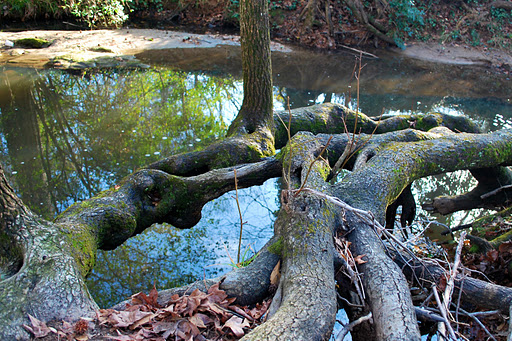
In last week’s post Two trees imitating life?, I wrote about two tree sculptures imitating life, or death, or maybe even tennis balls, depending on how you view the art. I promised to follow up this week with more about the blessed life being like a tree planted by water, and here’s a picture of some pretty cool tree roots to get you thinking of what the tree planted by water may look like:

Trees and their roots growing by a creek

The passage I shared with you last week actually describes two lives that are like trees, just very different kinds. One life is blessed, but the other is cursed.  Continue reading

Two trees imitating life?

I’ve been working on a book chapter about Jeremiah 17:5-8, in which Jeremiah compares a cursed man to a bush in the desert who will live “in a land of salt without inhabitant” (v. 6).

Well, I had never heard of a land of salt and really couldn’t picture what that might look like, and so I googled the phrase just to see what would come up. The Bonneville Salt Flats just outside of Salt Lake City, Utah, showed up in the list of hits.

If you read through the Google hits for the Bonneville Salt Flats, you’ll see words like “nothing for miles,” “desolate,” and “barren.” Famous races happen there, by car and on foot, but – and this is mainly for my sweet husband – please don’t feel like you have to go run the 100-mile race there … ever. (Even if you could leave your salt tablets at home and still be okay.) Despite the attraction for speed junkies, there’s a whole lot of nothing to this desert land.  Continue reading

The power of hope

Will you bear with me for one last post this season about Christmas trees? I promise it’s about more than just the tree that’s sitting out on our lawn waiting for the yard pickup tomorrow. It’s about the power of hope.

I had a hard time undecorating from Christmas this past weekend. I mean a pouting, near tears, really surprisingly difficult time. Only reluctantly did I take off the ornaments and pack them away, knowing that the tree couldn’t stay up much longer without starting to shed its needles. But for some reason, I didn’t want to let go.

There were actually several reasons. One – this tree was the quite simply the best tree we’ve ever had. We picked it out at a Christmas tree farm in the North Carolina mountains, where signs were plastered everywhere thanking us for participating in NC’s agritourism business. That was a new term for us, but we embraced it as a suitable description for marching around a hillside full of trees trying to pick the perfect one. Once we picked this one and the guys brought it down the hill for us, they called it a “fat boy.” It was really, really fat. I worried it would swallow up the room we were putting it in.  Continue reading