The purpose that prevails

“Many are the plans in a person’s heart, but it is the Lord’s purpose that prevails.” Proverbs 19:21 (NIV)

What did you want to be when you were little? If you’re like me, you daydreamed about becoming lots of different things. I made two paintings in elementary school two years apart that showed what I wanted to be when I grew up: an artist the first year, a teacher the second. Every year, sometimes every day, I thought up new things I wanted to be when I was older.

portraitoftheartistasayounggirl2013

My elementary school idea of what I’d grow up to be, complete with a change in eye color and a floating body (notice that my shoes aren’t attached to the rest of me).

It seems like even now I never stop dreaming about what direction my life will go next, but I have to remember not to get too carried away with myself. Proverbs 19:21 speaks to these plans in my heart, with a beautiful reminder that I’m not ultimately in charge (whew! that’s a relief).

With hindsight, there are plenty of times in my life that I’m grateful for God saying no, because He had something even better in mind for me. But I wasn’t very thankful when I was living in those moments. His “No” seemed difficult and even bewildering.

But now that I have seen bewilderment turn into blessing, I need to keep a firm grasp on the truth of Proverbs 19:21 as I work to fulfill the hopes and dreams and plans I have for my future. Continue reading

Spring hopes

For those of you who have been wondering if I’ve been neglecting my garden during the early spring with all the running my husband and I have been doing, you’re right. I have neglected my garden, and as a result, the chipmunks are winning a battle I didn’t realize we were already fighting this season.

When my husband and I came home from an out-of-town trip early this week, he went outside and stayed outside for a looooong time. When he came inside, he was steaming mad. Why? A beautiful camellia had tipped over, its roots eaten/disturbed by chipmunks tunneling around everywhere.

After several years of barely blooming, that particular camellia bloomed more abundantly this year, and a few weeks back, I took some photos of it:

A beautiful young camellia just weeks ago

A beautiful young camellia just weeks ago

I’m glad now that I photographed it when I did, because it may not survive the chipmunk wars to bloom another season. Its lovely blooms stayed well past a typical camellia season, probably because we’ve had a mostly chilly spring so far.

redcamelliabloom2013

A showy bloom from the camellia

My husband propped the camellia back up, and he filled in around it with dirt and my usual arsenal against varmints: permatill (tiny rocks that act as a soil conditioner and supposedly also as a deterrent to burrowing rodents like chipmunks); holy moley (mole repellent that apparently does not repel chipmunks); more dirt and new mulch; and holly tone (fertilizer to strengthen the camellia).

We have hope that our efforts will save the camellia, but it has already shed several yellow leaves, and the rest of the leaves look distressed. I’m not sure whether to cut it way back or leave it alone to see what parts may survive, if any. Master gardeners out there: I welcome your advice.

I’ve spent the last few days weeding and planning next steps for the garden, all the while listening for blasted chipmunks to chirp their way past the red camellia. I’m also trying to figure out the best way to protect the other two camellias we have, along with a young susanqua that is a transplant from my mother’s garden. Heaven help the chipmunks if they go there. Continue reading

There but for the grace of God

Spring has finally come to my part of the world, and I promise those of you still waiting with snow on the ground, spring will come to you, too. One sure sign of spring is March Madness, that time in the college basketball season when many of us spend too much time in front of the television and too much time at work talking about how our bracket picks are holding up.

On Easter, my parents came over for lunch, and they were somewhat incredulous that I wasn’t planning to watch Duke play Louisville later in the day. Their incredulity is fair, because when I lived under their roof, I was as avid a basketball fan as they come. And at one point, when I played in a youth orchestra at Duke and dreamed of attending Duke for college, I was an avid Duke fan. Watching Lousville beat Duke in the 1986 Championship game was very painful for me, and so I’m never anxious to watch Louisville play.

As Robert Frost writes, “Way leads on to way,” and I ended up attending an ACC school, but not of the blue and white ilk. My team made a hasty exit from the NCAA tournament this year, and so my interest level in the rest of the tournament had dropped to near zero.

So when I turned the television on Sunday afternoon, I hadn’t really been planning to watch basketball. I simply wanted to spend some downtime watching one of the shows I recorded from the past week. But the television was tuned to the basketball, and when I realized it was the Duke-Louisville game, I decided to watch for a few minutes.

I wish I hadn’t turned on the TV at all, because moments into my watching came that awful moment. You basketball fans know the one I mean. Louisville’s Kevin Ware was trying to block a Duke player’s 3-point shot, and when he came down … well, there was no mistaking the leg break. I cried out. I cried out again when the network replayed his leg breaking in slow motion. It is an image burned on my brain, and it made me feel sick. (I will not watch it again, and for those of you who haven’t seen it, I hope you’ll trust my decision not to link to a video of it here. It’s horrific, and you just don’t need to watch it.)

Continue reading

Joy in the delayed spring garden

For years I admired these odd but cheerful-looking flowers in other people’s gardens. Out on my run, I’d think, “I wonder what kind of plant that is? I’d love to have one in my garden.” They were sometimes the only blooming plant in winter gardens, and they burst forth with greater vigor in early spring.

Last year, a friend posted on Facebook a picture of some of them blooming in her garden, calling them by name. Thanks to her, I finally knew what to look for at my local nursery: Lenten Roses.

LentenRoses2013

One of my first Lenten Roses (Hellebore). Its profusion of blooms makes me happy.

I bought two last spring to plant in a new garden bed my husband was building around our lacebark elm tree. And I bought four more this fall. They’re all growing, and that brings me great joy. I’m already planning where I’ll add more, but I just missed a sale at my favorite nursery, and they’re not the cheapest plants to buy. Plus, it has been too darn cold to spend a lot of time outside digging in the dirt just yet.

A message on one of the plants from the fall has really stuck with me: Will self-sow where happy. Isn’t that true of us humans, too? Don’t we sow more seeds of happiness where we are happiest? We like to stick around in those places of happiness and visit them again in our memories. Continue reading

A city girl’s dilemma about her dinner plate

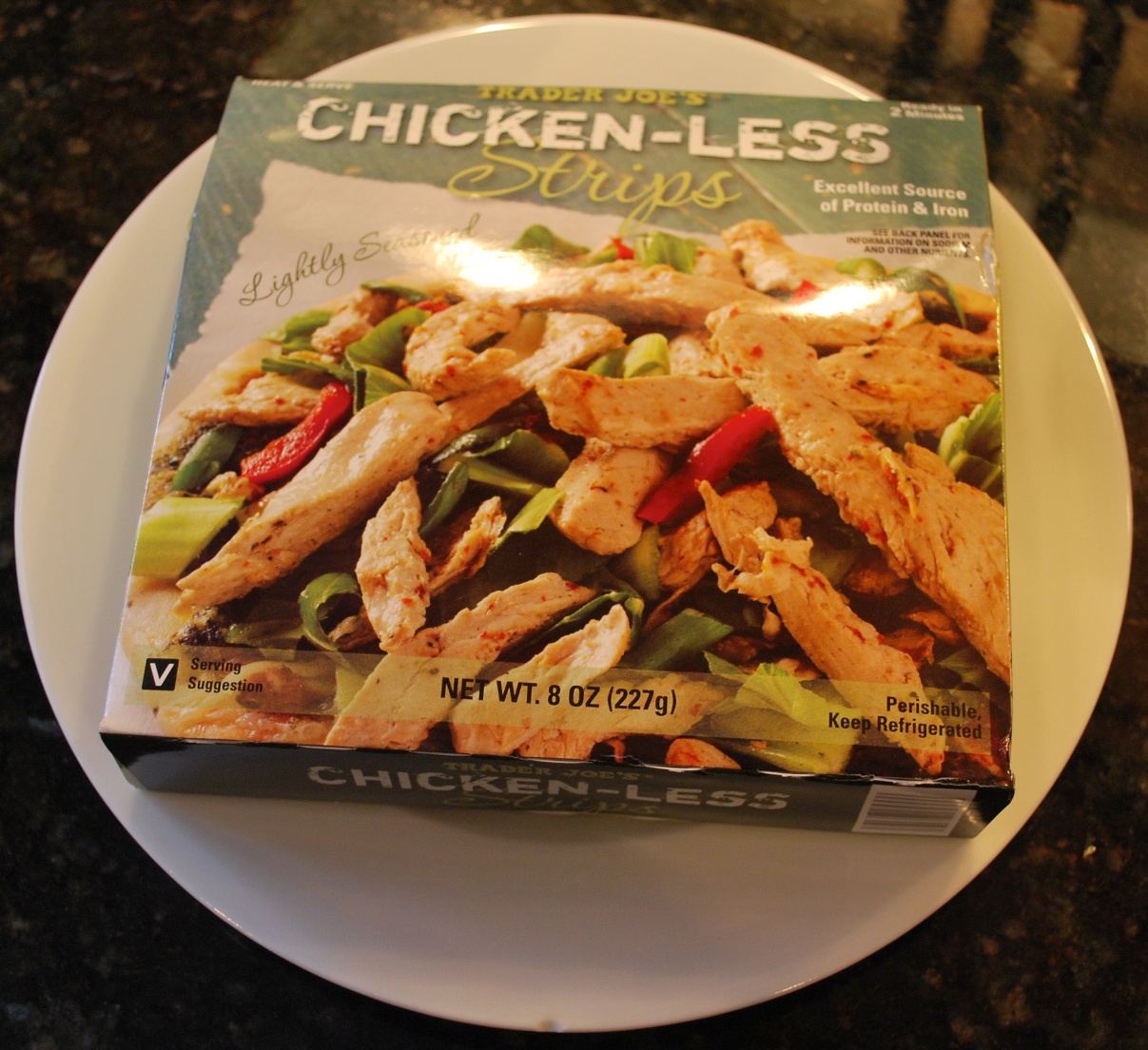
Vegan chicken-less strips?

Vegan chicken-less strips?

I don’t write much about food, but I hope you’ll allow me this digression today. A friend and I recently sat talking at her kitchen table about blogging and writing, and she asked me if I ever have a topic that just will not leave me alone until I write about it. I answered “Yes” without hesitation. My dilemma about my dinner plate is a perfect example.

To be or not to be … a vegetarian
Because I have an egg allergy, I’ve often joked with my husband that if I ever became a vegetarian, I might as well become a vegan, because I’d already be almost there.

The obstacle to me becoming a vegetarian or a vegan? I love meat and cheese, butter, ham broth and lots of other animal products. When I was growing up, I would look at my mom cross-eyed if she cooked a dinner that didn’t have some sort of meat in it. I would happily eat just about any meat she put in front of us (however, I ate asparagus – my least favorite vegetable – every day for a week one time just so I’d never have to eat liver again. I’m still waiting for a “thank you” from my dad and brother for that sacrifice because she never made it for them again, either.).

Our family traditions and gatherings often center on food, but most especially meet: turkey at Thanksgiving and Christmas, marinated lamb at Easter, barbecue for special birthday or anniversary celebrations. My sister-in-law makes a fabulous pork roast, and I can always count on my brother to whip up something tasty on the grill. I sometimes think I could eat chicken every day for the rest of my life and be perfectly happy.

Or I used to think that. A couple of weeks ago, I watched a documentary called Vegucated (a film I heard about thanks to a blog about running, exercise and food I’ve been following). The film-maker challenged three meat-eating New Yorkers to try a vegan lifestyle for six weeks, and during that time she educated them about where our meat comes from. I haven’t had chicken since.

There are haunting images of animals being castrated and killed in brutal ways. Of baby chicks being dumped off of conveyor belts into a box because they’re boy chicks (and therefore deemed useless). Of horrific cramped farm conditions. Of newborn calves dragged immediately away from their mothers and milk cows forced to give birth repeatedly to keep them producing milk. Of loads of dead fish getting dumped back into the ocean because they’re not the right kinds but had the bad luck to get caught up in the fishing nets.

It’s a damning indictment of how we treat animals to feed ourselves.

The invisibility of food production
I’m a city girl, always have been and probably always will be. That means I’ll always rely on grocery stores for most of my food. But that reliance does not acquit me of my responsibility to know how my food is produced.

When I was in college, I gave up eating veal while taking a philosophy class from a staunch vegan. I never knew before about the conditions veal calves were raised in until then, and it opened my eyes to the seemingly invisible way our food gets to the grocery store. But veal was all I was willing to give up.

When I was a high school English teacher, I’d give up meat for a few weeks while my students and I studied Upton Sinclair’s The Jungle but gradually slip back into my meat-eating habits.

My husband and I talked a few nights ago about my feeling equally troubled about becoming a vegetarian and not becoming a vegetarian. He eats very little meat anyway, and so it’s not much of a stretch to see him becoming a vegetarian, but he knows how much I rely on meat as part of my diet. He asked what I would need to continue eating meat.

I told him I wasn’t sure. Maybe meat from a local, small farm? But even with improved conditions, would that make the killing of an animal okay enough for me to put on my plate? If I would never kill a chicken myself, and I really dislike handling raw chicken meat, what makes it okay for me to eat it?

So I’m facing a dilemma and trying to make incremental changes in the meantime. I’m eating fish just once a week and dairy products maybe a little less than usual, but no other meat (though at some point I will have to decide what to do about what little is in my freezer). I’m also trying meatless options like the one pictured at the top of this post. I don’t recommend Trader Joe’s chickenless strips despite their promise of protein and iron. But I have had some faux chicken that I liked, so I know good alternatives exist.

As vegetarianism/veganism becomes more popular, maybe it will become an even easier decision to make. Even Justin Timberlake is on board (or at least his character on a recent episode of Saturday Night Live was, inviting us all to “Come on down to Veganville.”).

I’ll continue the debate with myself, and I’ll continue to educate myself. In the meantime, I invite you to weigh in, though I know that opening the floor to comments and opinions might only guarantee I become even more befuddled about the whole issue.