On poetry and place, and an Irish blessing for writers

My thoughts have been on Ireland of late, probably because St. Patrick’s Day is fast approaching. I missed last year’s St. Patrick’s Day parade in Raleigh, one of the largest parades the city hosts each year. After the parade, an all-day street festival breaks out, and I’m always torn between hanging out at the festival or going home to watch the ACC tournament. It’s an easier decision if my team is already out of the tournament.

This year, I’ll miss the parade, and I’m not sure I’ll be able to find tournament coverage out here. If it weren’t for Duke (Coach K’s wins) and Syracuse (sanctions), I’m not sure the ACC would have made it into the papers here at all this season. But I digress.

Along with a daily devotion, I’ve also been spending time in the mornings reading through The Collected Poems of W. B. Yeats, a tome I brought home from Ireland several years ago. I could have easily bought it at home, but I wanted it to come with me from Yeats’ own country.

County Sligo—the setting of many of Yeats’ poems and the place where Yeats spent much of his youth—has embraced Yeats as its greatest poet, and you’ll find a Yeats literary trail throughout the county. County Sligo is one of my favorite places on this earth, mostly for its rugged beauty and friendly people, and seeing a place so embrace its native poet only endeared it to me even more.

I read a poem of his yesterday that instantly transported me to a churchyard in Drumcliffe in County Sligo.

CountySligo2006_FT

This sculpture beautifully interprets Yeats’ poem He wishes for the Cloths of Heaven.

Had I the heavens’ embroidered cloths,
Enwrought with golden and silver light,
The blue and the dim and the dark cloths
Of night and light and the half-light,
I would spread the cloths under your feet:
But I, being poor, have only my dreams;
I have spread my dreams under your feet;
Tread softly because you tread on my dreams.

The final line resonates with me. Artists share our dreams with the world in many forms, and we hope the world will embrace what we offer.

Several friends of mine have released new books this year, and one of the most prominent (if superficial) ways the world treads on these books is by inviting reviews on websites such as Amazon and Goodreads. Some reviewers tread softly, offering warm words and a four- or five-star review. Others stomp and crush with cruel reviews. If I were to offer an Irish blessing to my writing friends this year, it would look something like this:

May your light always burn bright.
May your pen’s ink freely flow.
May Amazon’s reviews bring only delight,
And silence the one-star review.

How about you? What dreams of yours do you hope the world will treat with kindness? What Irish blessings would you like to share with your friends to uplift them?

Will you celebrate St. Patrick’s Day by going to a parade or seeing Irish dancers or listening to some fiddle tunes? Maybe you’ll read a Yeats poem or two? If you do, I hope you’ll let me know your favorite lines. However you choose to celebrate, have a happy St. Patrick’s Day.

Stacking the river rocks

Yesterday was a beautiful morning, cool and quiet with the sun streaming down. I walked down to the river, part of my usual morning routine now, and began looking for cairns. For a few weeks now, I have noticed little stacks of stone popping up along various trails. A particular collection of cairns captured my interest the day before.

I brought my phone with me, not wanting the weight and bulk of my better camera, but when I got to the place where the cairns had been, a pile of scattered rocks greeted me. I decided to search for others. Even if I found none, the morning’s walk would be worthwhile simply because of the beauty of the day.

I didn’t have to walk far, though, before I came across something more sculpture than cairn.

CairnsSculpture2015_FT

I was delighted to find this sculpture on a side trail I seldom take.

I’m glad I took a picture of it yesterday. This morning, it was already a mere heap.

I’m curious about who builds the cairns and sculptures. And I’m equally curious about who knocks them down. Is it the same person? Are several people playing a game of hide and seek with one another, one person building up a cairn and another saying, “I found you” by tearing it back down? Or maybe the cycle of creation and destruction is more random?

SmallCairns2015_FT

Two small cairns are all that remain from a group of five or six I noticed last week.

The area around the river was mined for gold through the 1950s, and huge rock piles called tailings serve as a reminder of those days. There is a project underway to build up gravel beds in the river for spawning salmon and other fish, but I can’t see how all that extra rock could possibly fit into the river. The remaining rocks give cairn makers and sculpture artists endless ways to play and meditate and shape their surroundings.

RiverRock2015_FT

Mining near the river has displaced ample rock to inspire cairn builders and rock sculptors.

While I was out running this morning, I took another trail I’d never noticed and found what appears to be the primary gravel excavation area for moving rock into the river. At the base of the deep pit sat cairns and the obligatory rocks in the shape of an arrow-struck heart with someone’s initials in it.

I smiled and kept on running, leaving the heart and the cairns to stay until someone else comes along to reshape them.

Why do we stack rocks? Why do we build cairns? Early stories in the Old Testament speak of altars, monuments and rock piles as way-finding markers. I especially love the story in Joshua of the men building a stone memorial on the banks of the Jordan to help generations of Israelites remember the crossing there:

Joshua said to them, “Cross again to the ark of the Lord your God into the middle of the Jordan, and each of you take up a stone on his shoulder, according to the number of the tribes of the sons of Israel. Let this be a sign among you so that when your children ask later, saying ‘What do these stones mean to you?’ then you shall say to them, ‘Because the waters of the Jordan were cut off before the ark of the covenant of the Lord; when it crossed the Jordan, the waters of the Jordan were cut off.’ So these stones shall become a memorial to the sons of Israel forever.”

Thus the sons of Israel did as Joshua commanded, and took up twelve stones from the middle of the Jordan … and they are there to this day.

– Joshua 4:5-8, 9

This story reminds me of sitting with a beloved former minister of my church, as we talked about my book and his upcoming sermon. I can hear his booming voice and see the twinkle in his eye as he talks about the children asking, “Grandaddy, Grandaddy, what do these stones mean to you?”

The stones and cairns I pass by each morning may not have much meaning to me,  because they have not had time to become part of my history. But they still manage to conjure up stories and memories from home.

Planting roots in the rocky soil
Speaking of rocks, I dug into the earth this past weekend, a first planting in our new garden: a Jerusalem Sage. I was delighted to find this drought-tolerant gem of a plant at a nearby nursery—a place where I could spend way too much time and money.

The soil was full of little rocks as I dug. I was glad I hadn’t bothered bringing any of the rocky soil amendment so important to the clay soil of my North Carolina home. It is unnecessary here.

I promise an update when the blooms open.

Little Free Libraries and building community

When my husband and I came to California to house hunt, we had two days to look at 16 houses. One of the moments that stands out in my mind is passing by a Little Free Library on a street near one of the houses for sale. I got really excited, and I’m pretty sure my enthusiasm surprised both my husband and our agent. Any neighborhood that had a Little Free Library was more than all right with me.

Not familiar with the Little Free Library movement? Its basic premise is to share books within a community. People build a box to hold books, put it in their yard, and then their neighbors start sharing books. I love this!

LFL sign_2015FT

Exchanging books: The point of a Little Free Library

On Friday my husband reminded me of that Little Free Library by sending me an article about some small-minded folks who are hassling the owner of a Little Free Library. I read the article and immediately wanted to start building a Little Free Library of my own to stake in the front yard. Of course, I’d have to check with the homeowners’ association first (I recognize the irony). And, more to the point, I have no wood-working skills. So there went that idea.

My temper cooled when I skimmed the article’s comments, something I don’t normally do because, well … trolls. As I scrolled down, I saw a long comment from the director of marketing for Little Free Libraries. She asserted that most of these little neighborhood gems are not in trouble and pointed out the complexities of the specific (unofficial) library in question.

That doesn’t mean we shouldn’t pay attention in our own communities about how Little Free Libraries flourish, or stir up trouble, or bring neighbors together or bring out the trolls. We should know, and we should celebrate Little Free Libraries’ successes. If you read the first paragraph or two of the CityLab article, you’ll see why Little Free Libraries deserve positive attention and why they deserve our protection. They play a small part in creating community.

Little Free Libraries play a small part in creating community.

So to celebrate Little Free Libraries and get to know my way around my new community a little better, I drove around in search of Little Free Libraries near me. There’s a handy map of them all over the world, and I used the map and its more complete appendix to plan the places I would visit. The tour gave me a fun reason to learn my way around roads I might not otherwise ever see.

LFL_one2015FT

Someone took a lot of care on the shingles for this cute Little Free Library

LFL_booksone2015FT

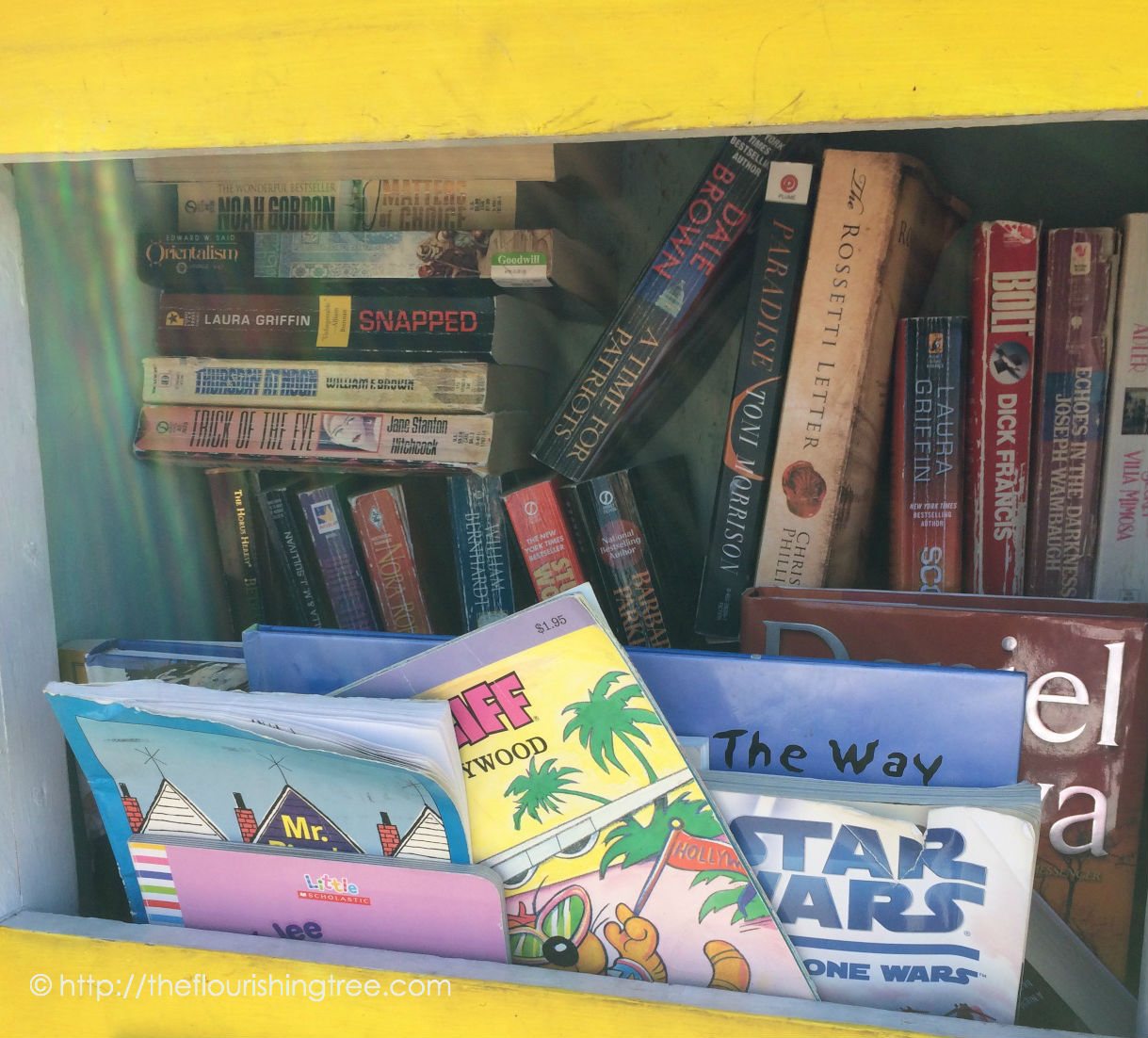
A wide collection of reading material, but I was sad there weren’t any children’s books here.

LFL_yellow2015FT

A happy yellow Little Free Library, this one with an asphalt shingled roof

LFLs_bookstwo2015FT

Yay for children’s books (especially Star Wars) and for adult lit books such as Toni Morrison’s Paradise, one of my favorite reads from last year

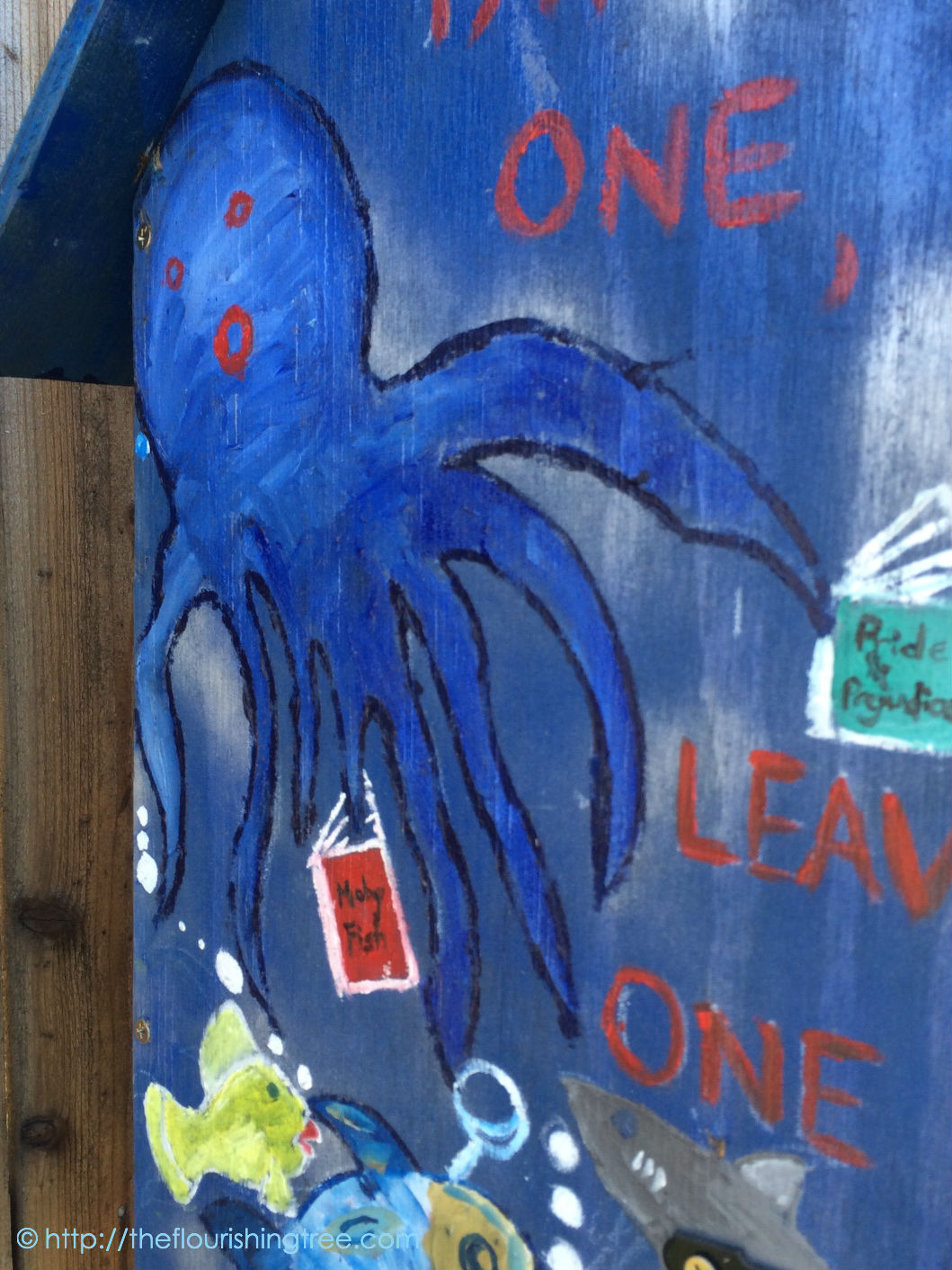
My favorite Little Free Library of the trip was this one for its whimsical decorations:

LFL_three2015FT

Someone(s) must have had a lot of fun decorating this one.

LFL_threebooks2015FT

Not just books for adults and kids, but crayons and toys, too, along with a log book and a note pleading for the return of log book #1. Not cool, log book thief, not cool.

LFL_threedetail2015FT

I love that the octopus is reading two books at a time, both “classics.”

I encourage you to look at the map for Little Free Libraries to find some near you. Don’t have one? Consider building your own. What books would you most like to share in a Little Free Library?

Speaking of free books, Saturday is the last day to enter for your chance to win a free copy of The Flourishing Tree on Goodreads. I also need to figure out what to do with some copies of the book that arrived damaged—maybe add them to Little Free Libraries? What do you think?

Snow, ashes and forced pauses

I ran yesterday morning, not long or far, but I was grateful to be able to run. After a year+ of fighting an injury, I’m starting to run consistently, and that’s a gift I do not take for granted.

I know, too, that if I had not moved from North Carolina to California, I would not have been able to run yesterday. Or today. Or tomorrow. Raleigh is covered in ice, and if there’s one surface I refuse to run on, it’s ice (not to mention that 18º is my minimum temperature for running even on the driest road).

I hear that snow is falling there now, adding to the layers of snow, sleet and ice—a pretty sight if you can watch it from the warmth of your home, but miserable if you have to go outside for long. A howling, bitter cold is coming next.

Here’s NOAA’s seven-day forecast for Raleigh:

frigidforecast2015

There’s the kid part of me that already misses snow days. Photos on Facebook show sledding and snow falling and the world blanketed in a glazed white. Schools stay closed, while families stay inside and read books, watch movies or play games. They make smores and hot chocolate and cinnamon buns.

My dog has always loved snow days, especially when it snowed enough to fully bury her tennis ball and turn it into a popsicle to dig up over and over. I know she doesn’t remember what she’s missing, but I miss it a little for her, the unbridled glee she felt on those days. Here’s a shot of her from one of our snow days last year:

snowydaydog2014FT

Part of me doesn’t miss these snow days, though, especially as cold as Raleigh is right now. Aside from the inevitable cabin fever, there is fretting for my husband and others like him who have to navigate icy roads to get to and from work.

snowydayheadaches2014FT

There’s the knowledge that children who rely on free or reduced lunch programs at school are going hungry. And there are the cries for help from homeless shelters bursting at the seams with dangerous white flag nights one after another. For too many, snow days mean fighting for life. (If you’re blessed with plenty, consider a donation to Backpack Buddies or the Raleigh Rescue Mission?)

Because of the icy roads, churches are canceling Ash Wednesday services. In its cancellation notice, my Raleigh church invited members to mark the occasion at home or with neighbors. I hope many of my church family will take them up on that suggestion.

Snow days force a stop in our regular pace of life, and maybe that’s something else I miss.

So much distressing news across the world has me reeling more than usual lately: 21 Christian Egyptian martyrs; three muslim students (all shining young Americans who grew up in my hometown) shot dead in a senseless act of rage; continued extremist violence in Nigeria; even anti-Semitic activity at nearby UC Davis. I cannot make sense of any of it.

The snow blanketing the roads doesn’t cover these troubles, but it does force a pause, a community’s collective inhalation. And it provides still, quiet moments to help us decide where God is calling us to spend our energies next.

The same could be said of the ashes that mark us this first day of Lent. They do not hide our faults, but they do encourage a change from our normal routine and an examination of how we are to prepare for the season ahead.

Sometimes it’s in the pauses that God can move us the most.

To my friends in snowy places, how are you pausing? To my friends who cannot imagine living in such cold places, what encourages you to pause?

February freebie

Hi, friends,

Here’s a bonus post with some fun news.

February isn’t my favorite month. Maybe you feel the same? To spread some cheer, I’m giving away copies of The Flourishing Tree over at Goodreads. You can enter through the end of February:

Goodreads Book Giveaway

The Flourishing Tree by Hope Squires

The Flourishing Tree

by Hope Squires

Giveaway ends February 28, 2015.

See the giveaway details
at Goodreads.

Enter to win